
Reflections of Chartres Cathedral, August, 2005
Posted in Architecture, Europe, Foreign Travel, Photography, Religion | Leave a Comment »
 “You may feel as if you’d stepped into a quirky 19th-century museum, but that’s not how Mr. [Peter] Guttman, a travel photographer, sees the densely packed four walls, floor and ceiling of his family’s living room. His meticulously organized collection of rare folk art and handmade tools, toys, weapons, textiles, baskets, ceramics, etc., dedicated to the memory of extinct or nearly-so ways of life and assembled as snugly as a jigsaw puzzle, is ‘a mirror of my personal life,’ he said, ‘a diary of global travels.'” (Audio Slide Show) (via NY Times)
Posted in Antiques & Folk Art, Collectors & Collecting, Ephemera, Foreign Travel, New York City, Photography, U.S. Travel | Leave a Comment »
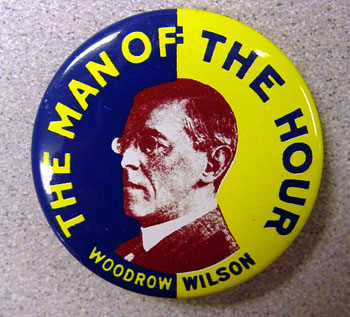 Will the Bush 43 presidency be remembered more like Harry Truman’s, as Bush supporters hope, or Herbert Hoover’s, the odds-on favorite? Several historians argue that “A more apt comparison is to Woodrow Wilson.”
“[Woodrow] Wilson is the only other American president who had a faith-based foreign policy, who asserted the president’s absolute primacy over Congress in foreign affairs, who initiated a crusade ‘to make the world safe for democracy.’ He sent troops to invade one foreign country (Mexico), then, aided by a pretense (an intercepted German telegram fancifully offering to finance a Mexican war against the US), dispatched a million troops to join a European war, at the cost of 40,000 American lives and much domestic upheaval . . . Wilson left his party in a shambles, and the country in a virulent 18-month recession.” (via Economic Principals)
Posted in Bush, Politics | Leave a Comment »
 In the ancient Cambodian capital of Oudong, at the base of Phnom Oudong, children hire themselves out as companions, with fans, to visitors to the Royal Tombs, December, 2006.
Posted in Asia, Foreign Travel, Photography | Leave a Comment »

Felix Nussbaum, Le Réfugié (The Refugee), 1939
“Is there a Jewish art?” Harold Rosenberg asked at New York’s Jewish Museum in 1966. “They build a Jewish Museum, then ask: ‘Is there a Jewish art?’ Jews!”
(via Financial Times)
Posted in Art & Artists, Jewish Life, Museums & Exhibitions, Religion | 1 Comment »
 “[Walker] Evans is foremost a giant of 20th-century photography, the instigator of a lean, elegant documentary style that was as unvarnished as it was ennobling. He immortalized gaunt sharecroppers, dilapidated plantations and bone-dry country stores in the South; worker housing and grimy factories in the industrial North; and (with a hidden camera) the unguarded expressions of New York subway riders.
“But before he was anything else, Evans was an obsessed collector of postcards. This exhibition reveals them as the through line, the wellspring of his art.”
At the end of her review of the just-opened exhibition, “Walker Evans and the Picture Postcard,” (Metropolitan Museum of Art, New York), Roberta Smith notes the broader cultural significance of early 20th-century picture postcards and laments the slashing of financial support for public school art programs:
“Without diminishing his achievement, this show reverberates beyond Evans. The postcards celebrate America at the beginning of the last century. They also confirm the vigor of this country’s often anonymous grass-roots art forms and the importance of popular culture to so-called high art. More sadly, in a time when schools across the country are slashing their art programs, this unusual exhibition suggests the often decisive effect of our earliest aesthetic experiences. ‘Home is where we start from,’ wrote the psychologist D. W. Winnicott. The richer the formative experiences there, the better for everyone.”
Related
Posted in Collectors & Collecting, Ephemera, Museums & Exhibitions, Photography, Popular Culture | Leave a Comment »
 Gypsy mother braiding her daughter’s hair at Vienna’s popular Naschmarkt, May, 2007
Posted in Europe, Foreign Travel, Photography | Leave a Comment »
 “Dewey Martin, drummer for the short-lived but long-resonating rock band Buffalo Springfield whose career after the group split never ignited like those of his former band mates Neil Young and Stephen Stills, has died. He was 68.”
(via LA Times)
Posted in Obituaries, Popular Culture, Popular Music, Rock 'n' Roll | 1 Comment »
 “Milton Parker, who brought long lines and renown to the Carnegie Deli in Manhattan with towering pastrami sandwiches and a voluble partner who kibitzed with common folk and celebrities alike, died in Queens on Friday. He was 90 and lived in Manhattan. . . .
‘In the history of delicatessens, Milton Parker’s Carnegie Deli caused more heartburn to the Jewish world than anything I’ve ever heard of,’ Freddie Roman, the veteran borscht belt comedian, said this week on the savethedeli Web site. ‘His pastrami sandwich was incredibly much too large for human consumption.’” (via NY Times)
[Parker was born the same year as my father and both grew up in Williamsburg, Brooklyn. Parker’s passing reminds me of my father’s frequent boasts of having served in the same Army battalion as the owner of the Pastrami King, the venerable Queens Boulevard delicatessen that my father proudly referred to as the “Carnegie of Queens.”]
Related
Posted in Business, Food & Wine, Jewish Life, New York City, Obituaries | Leave a Comment »
 While the completion of the final 670-mile stretch of security fence along the U.S.-Mexico border continues to be slowed by political and engineering issues, across the more than 600 miles of fence already completed (“a hodge-podge of metal panels, wire mesh and steel posts”) “drug smugglers . . . continue to breach the fencing that is up, forcing Border Patrol agents and contractors to return again and again for repairs. The smugglers build ramps to drive over fencing, dig tunnels under it, or use blow torches to slice through. They cut down metal posts used as vehicle barriers and replace them with dummy posts, made from cardboard.”
Teddy Cruz, reporting for “The Nation,” writes that “no matter how high and long the post-9/11 border wall becomes, it will never stop the migrating populations and the relentless flows of goods and services back and forth across the formidable barrier that seeks to exclude them.” Yet from the southward flow of materials something remarkable is being created – “while human flow mobilizes northbound in search of dollars, the urban waste of San Diego moves in the opposite direction . . . The leftover parts of San Diego’s older subdivisions — standard framing, joists, connectors, plywood, aluminum windows, garage doors — are being disassembled and recombined just across the border. A few miles south, in Tijuana, new informal suburbs — some call them slums — spring up from one day to another. This river of urban waste flows across the Tijuana-San Diego [sic] to make something dramatically new.”
Posted in American West, Architecture, Crimes & Misdemeanors, Current Events, International Affairs, Politics, The Americas, Urban Affairs | Leave a Comment »
 “In order to keep some 6.5 million TV screens from going dark two weeks from now, both houses of Congress have now voted to postpone the deadline for a changeover from analog to to digital television transmissions from February 17 to June 12. The president has been pushing for the delay, and despite delays from peevish Republicans, he got it. It remains to be seen whether the postponement will be enough to resolve what has by now become a completely failed government program–another parting gift from the Bush administration, which managed to raise government incompetence to new levels, while always seeming to shaft the nation’s most vulnerable people.”
(via Mother Jones)
Related
Posted in Bush, Business, Congress, Obama, Science & Technology, Television | Leave a Comment »
 “Don’t Piss Here” – Painted message on brick wall in residential section of Hanoi, Viet Nam, December, 2006 (note evidence of just-concluded disobedience along bottom of wall at lower left)
Posted in Asia, Foreign Travel, Photography | Leave a Comment »
 “Because of widely available broadband access and a new wave of streaming sites, it has become surprisingly easy to watch pirated video online — a troubling development for entertainment executives and copyright lawyers.”
(via NY Times)
[Earlier this week, for the first time, I watched a pirated movie, a DVD copy of a current-run Academy Award-nominated film apparently reproduced from an advance review video (during an early scene, for a few seconds, a message appeared on the bottom of the screen warning against reproduction or distribution of the video). I must admit to having had some misgivings about watching the DVD, yet what I mostly thought about was how commonplace it is to find for sale legally in bookstores, uncorrected proofs or review copies of new books sold to the stores by editors and reviewers, often in advance of the books’ release. Review copies of new books, not intended for resale, are so ubiquitous in New York City that it has become hard for me to justify paying full price for new titles.]
Posted in Books, Business, Cinema, Crimes & Misdemeanors, Economy, Popular Culture, Science & Technology, World Wide Web | Leave a Comment »
 Flower petals scattered by children during procession celebrating the Feast of Corpus Christi in Tarnow, Poland, May, 2008
Posted in Europe, Foreign Travel, Photography | Leave a Comment »
 “The Oscar Wilde Bookshop in Greenwich Village, which is believed to be the oldest gay and lesbian bookstore in the country, will close on March 29, its owner announced on Tuesday, citing “the current economic crisis.” The announcement came nearly five years after the store was about to close, only to be given a last-minute reprieve when a new owner purchased it.”
(via NY Times)
Posted in Books, Business, Economy, New York City, Sex & Gender | Leave a Comment »
 The New York Times ran an obituary yesterday about Joseph Ades, “the white-haired man with the British accent, the expensive European suits and shirts,” who had been a fixture among the vendors at the Greenmarket in Manhattan’s Union Square. I was drawn to the article not because of a remembered encounter with Ades but because of my interest in the legal obstacles facing street vendors, often immigrants and people of color, in New York City. In the Times’ obit, David Hughes, the operations manager at the Greenmarket, noted that Mr. Ades conducted his business on the fringes of the market “because he never obtained a permit to do business there, and if he staked out a spot too close to the vendors, someone would complain and security guards would be alerted.” Although Ades managed to persist through this wink-wink arrangement, most street vendors are not so fortunate.
New York’s Urban Justice Center, a non-profit organization that serves “New York City’s most vulnerable residents through a combination of direct legal service, systemic advocacy, community education and political organizing,” several years ago established the “Street Vendor Project” to assist vendors who have been victims of New York’s aggressive “quality of life” crackdown (vendors have been denied access to licenses, restricted from streets closed to them at the urging of powerful business groups, or penalized with onerous fines for minor violations).
The most successful of the project’s public fundraisers is the “Vendy Awards,” a juried competition between five or six of New York’s best “street chefs,” with the winners determined by the attending public (who pay for the pleasure of sampling the various fare – all proceeds going to support the project’s work) and a panel of food “experts.” This past fall, the judges at the fourth annual event, held at the Tobacco Warehouse in DUMBO, included well-known food writer and journalist Calvin Trillin.
As to Mr. Ades (R.I.P.), his story, as told in the obituary, is a romantic one, to be sure, but better to ask almost any New York City vendor for his or her story if you want the real word on the street.
Posted in Business, Crimes & Misdemeanors, Food & Wine, New York City, Obituaries | Leave a Comment »

Marfa, Texas, long a tourist destination for devotees of paranormal phenomena who journey to this remote desert outpost for a chance to experience the Marfa Lights, is still in many ways a typical small Texas town where languorous locals are animated by talk of high school football. But when I visited Marfa two years ago while en route to Odessa, Texas for a reunion of my wife’s family, the entire town seemed like a mirage: there, deep in the heart of George Bush country, were art and photography galleries, a public radio station serving “Far West Texas,” and a coffee shop, The Brown Recluse, providing customers with reading copies of such un-Bush publications as “The Nation” and “The New York Review of Books” while serving some of the best fresh roasted coffee (organic and free trade) on either side of the Rio Grande. Marfa owes its current status as an art destination to the American painter and minimalist sculptor Donald Judd who moved to town in 1971 with hopes of realizing his art on a “grand scale.”
Related
Posted in American West, Art & Artists, Food & Wine, U.S. Travel | Leave a Comment »
 “Of all the truly seismic shifts transforming daily life today — deeper than our financial fissures, wider even than our most obvious political and cultural divides — one of the most important is also among the least remarked. That is the chasm in attitude that separates almost all of us living in the West today from almost all of our ancestors, over two things without which human beings cannot exist: food and sex.
“The question before us today is not whether the two appetites are closely connected. About that much, philosophers and other commentators have been agreed for a very long time. As far back as Aristotle, observers have made the same point reiterated in 1749 in Henry Fielding’s famous scene in Tom Jones: The desires for sex and for food are joined at the root. The fact that Fielding’s scene would go on to inspire an equally iconic movie segment over 200 years later, in the Tom Jones film from 1963, just clinches the point.
“Philosophers and artists aside, ordinary language itself verifies how similarly the two appetites are experienced, with many of the same words crossing over to describe what is desirable and undesirable in each case. In fact, we sometimes have trouble even talking about food without metaphorically invoking sex, and vice versa. In a hundred entangled ways, judging by either language or literature, the human mind juggles sex and food almost interchangeably at times. And why not? Both desires can make people do things they otherwise would not; and both are experienced at different times by most men and women as the most powerful of all human drives.” (via Policy Review)
[Rodney Dangerfield had a bit about food replacing sex in his marriage, something along the lines: “I’m telling you my love life is terrible. My love life is so bad, food has replaced sex in my marriage – things are so bad my wife and I even installed a ceiling mirror over our kitchen table.”]
Posted in Food & Wine, Sex & Gender | Leave a Comment »
 After 11 years in New York, illustrator Christoph Niemann moved to Berlin with his wife and young sons. “During the cold and dark Berlin winter days, I spend a lot of time with my boys in their room. And as I look at the toys scattered on the floor, my mind inevitably wanders back to New York.” (via NY Times)
Posted in New York City | Leave a Comment »
“Is it the seamlessly blended amber and caramel colors, the slowly gliding camera work? Or is it the sentiments that fall like flakes of wet snow into the dialogue? Many elements join to make the beautifully crafted “Curious Case of Benjamin Button,” with a running time of two hours and forty-seven minutes, the best picture in years for a postprandial rest (popcorn division). As you may have noticed, 2008 was not a great year for movies. There was nothing comparable to the hair-raising “There Will Be Blood,” or the ravishing “Diving Bell and the Butterfly,” or the sinister “No Country for Old Men,” from 2007. Even so, a nod for best picture could have gone to more deserving movies, such as Jonathan Demme’s “Rachel Getting Married,” which settles down into a revelatory examination of a family’s anguish and joy; or “Happy-Go-Lucky,” Mike Leigh’s startling look at the power and the limits of goodness; or even the animated masterpiece “WALL-E,” with its vision of the end of industrial civilization and its ironic salvation in an anodyne space station decorated in cruise-liner moderne. The total of thirteen nominations for “Benjamin Button” has to be some sort of scandal. “Citizen Kane” received nine nominations, “The Godfather: Part II” eleven, and this movie, so smooth and mellow that it seems to have been dipped in bourbon aging since the Civil War, is nowhere close to those two. In fact, of the five nominees for best picture—“Milk,” “Frost/Nixon,” “The Reader,” “Slumdog Millionaire,” and “Benjamin Button”—only “Milk,” a bio-pic with a thrilling sense of history and lots of jokes and sex, has the aesthetic life and human vitality that warrant its nomination.” (via The New Yorker)
[I have never considered David Denby, the longtime movie critic for “The New Yorker” magazine, a curmudgeon, yet my response to his complaints about this year’s Oscar nominees for “Best Picture” is a keen, albeit spiteful, desire to see them all before the winner is announced. Pass the popcorn.]
Related
Posted in Cinema, Movie Reviews, Popular Culture | Leave a Comment »
 The 'Not-So-Rough' Guide