April 12, 2009 by jerrysmolin
 “A Philadelphia cable network’s early morning broadcast of a Good Friday service at the Vatican abruptly changed to something wildly different – a 30-second ‘Girls Gone Wild‘ ad.
“Comcast spokesman Jeff Alexander says the 2 a.m. Friday programming glitch was due to a required test of the Emergency Alert System. He says such tests are usually done in the overnight hours.
“The test automatically tunes viewers to a preselected channel that would provide information in the event of an emergency. But during tests, the channel airs regular programming, which in this case included a paid advertisement for the racy videos.
“Alexander says the problem affected the network’s entire local area, but only one person called to complain.” (via Huffington Post)
Posted in Media & Advertising, Popular Culture, Religion, Sex & Gender, Television | Leave a Comment »
April 11, 2009 by jerrysmolin
 Robert Crumb‘s cover for “The Last Supplement to the Whole Earth Catalog,” from Jeremy Barker’s collection of 100+ pop culture adaptations of Leonardo da Vinci’s The Last Supper. (more @ “Popped Culture,”; via Wired)
[Click image for a larger version of the R. Crumb cover.]
Posted in Art & Artists, Popular Culture, Religion | Leave a Comment »
April 11, 2009 by jerrysmolin
 “An anonymous bidder acquired the ‘King of Cowboys’ Roy Rogers‘ OM-45 Deluxe Martin guitar at Christie’s on April 3. One of the rarest and considered among many collectors the most coveted Martin guitar, the 1930 instrument was put up for auction by the Roy Rogers-Dale Evans Museum in Branson, Mo., and attracted a winning bid of $554,500.” (cont’d @ Antiques & the Arts)
Posted in American West, Antiques & Folk Art, Collectors & Collecting, Popular Culture, Popular Music | Leave a Comment »
April 11, 2009 by jerrysmolin
 [Living part-time in Brooklyn, New York and part-time in Northampton, a college town in western Massachusetts, I am unsurprised by the findings that the northeastern states are among the most neurotic, as well as among the most open, “openness” reflected by “curiosity, intellect, and creativity at the individual level.”]
From “The Geography of Personality”:
Neuroticism is characterized by ‘anxiety, stress, impulsivity, and emotional instability and is related to antisocial behavior, poor coping, and poor health.’ Unsurprisingly, the study found that highly neurotic states had lower rates of exercise, higher rates of disease, and a shorter life expectancy. In these states, people are less likely to join clubs and spend time with friends. The geographic clustering of neuroticism is strong: it’s prevalent in the Northeast and much of Appalachia, and, for some reason, in the states of the lower Mississippi Valley. The West is decidedly less neurotic than the East, you may be unsurprised to hear.
(More @ The Map Scroll, including maps charting the geographical variations of “the big five” personality traits: Extraversion, Agreeableness, Conscientiousness, Neuroticism, and Openness.)
Related: A Theory of the Emergence, Persistence, and Expression of Geographic Variation in Psychological Characteristics
Posted in American West, Health & Medicine, Human Behavior, New England | Leave a Comment »
April 10, 2009 by jerrysmolin
 “It is too early to proclaim a bona fide trend in elective sterilization, because no organization regularly tracks the number of vasectomies performed on an annual or even a monthly basis. The most recent comprehensive data come from a study published in The Journal of Urology in 2006, which estimated that about 527,000 vasectomies were performed in this country each year.
“But the recent anecdotal data, if they hold, would have a historical parallel in the Great Depression, when the birth rate fell sharply.” (more @ NY Times)
Posted in Economy, Health & Medicine | Leave a Comment »
April 10, 2009 by jerrysmolin
 [“I’m shocked, shocked to find that gambling is going on in here!” (Claude Rains in “Casablanca”)]
“The list of governors threatening to decline federal stimulus money last month read like a list of Republicans considering running for president in 2012: Govs. Mark Sanford, Bobby Jindal and Sarah Palin led the anti-stimulus charge.
“But what began with a bang is ending with something closer to a whimper. . . .
“All three found that praise from the conservative movement in Washington meant nothing to furious state legislators of both parties. And in the end, along with other conservative Republican governors, the three submitted letters in recent days asking to be eligible for federal funds, a spokesman for the White House Office of Management and Budget confirmed.” (more @ Politico.com)
Posted in Current Events, Economy, Politics | Leave a Comment »
April 9, 2009 by jerrysmolin
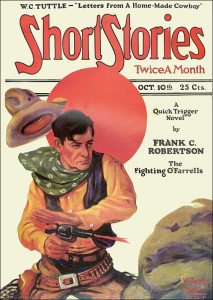 In Sunday’s New York Times, A.O. Scott writes in praise of the American short story (long my favorite literary form), challenging “the conventional wisdom in American letters . . . that size matters, that the big-game hunters and heavyweight fighters . . . go after the Great American Novel,” and posits this fascinating future for short fiction:
“The new, post-print literary media are certainly amenable to brevity. The blog post and the tweet may be ephemeral rather than lapidary, but the culture in which they thrive is fed by a craving for more narrative and a demand for pith. And just as the iPod has killed the album, so the Kindle might, in time, spur a revival of the short story. If you can buy a single song for a dollar, why wouldn’t you spend that much on a handy, compact package of character, incident and linguistic invention? Why wouldn’t you collect dozens, or hundreds, into a personal anthology, a playlist of humor, pathos, mystery and surprise?
“The death of the novel is yesterday’s news. The death of print may be tomorrow’s headline. But the great American short story is still being written, and awaits its readers.” (more @ NY Times)
Posted in Book Reviews, Books, Literature, Writers & Writing | Leave a Comment »
April 9, 2009 by jerrysmolin
 “Thirty years ago the American Jewish fiction of Philip Roth and Saul Bellow was all about Yiddish insults, blonde shiksas, and getting away from the past. Today’s talented crop of young Jewish writers, such as Nathan Englander, Michael Chabon, and Dara Horn, are weaving tales bound in a newfound ethnic pride that has revitalized Jewish literature in America.” (cont’d @ Vanity Fair)
Posted in Books, Jewish Life, Literature, Religion, Writers & Writing | Leave a Comment »
April 9, 2009 by jerrysmolin
 “In “Defiance,” a clunky but well-meaning action film set during World War II and starring Daniel Craig, the Bielski brothers save hundreds of fellow Polish Jews by battling Nazis in the Belarussian forest. Directed by Edward Zwick and based on a true story, the movie, released around New Year’s, tried among other things to counter Hollywood’s usual tales of Jewish helplessness during the Shoah.
“Whether it did, or instead implied that Jews who didn’t fight bore a measure of responsibility for their own fate, became a matter of some passing debate in America.
“But the film provoked a different sort of fuss shortly before it arrived here some weeks later. Movie critics in Poland wondered whether Hollywood would ever get around to showing Polish partisans as heroes, as opposed to anti-Semites. . . .
“As Europe diversifies, nearly every nation and culture on the continent seems to battle for victimhood status. Poles have especially good reason to see themselves as long oppressed, having been fought over and occupied for much of the last century by vicious regimes. Shifting political power struggles during and after the war, among other complications of Polish Jewish history, led some Polish Jews at certain points to side with Soviets against Nazis and Polish partisans. The whole moral morass, essential to Polish identity, tends to be lost on outsiders, many of whom unthinkingly regard the country, throughout most of the last century at least, as just a Jewish killing field.” (more @ NY Times)
Posted in Books, Cinema, Europe, Foreign Travel, International Affairs, Jewish Life, Movie Reviews, Museums & Exhibitions, Politics, Popular Culture, Religion | Leave a Comment »
April 9, 2009 by jerrysmolin
 “The Crumpled Press, the brainchild of [Jordan] McIntyre and [Alexander] Bick, publishes work by new authors and sets previously unpublished, notable lectures and articles into proper books — hand-sewn — on culture, politics, self-reflection, and poetry. ‘It’s original, thought-provoking work that might otherwise be tossed aside,’ says Bick, who is pursuing a history PhD at Princeton. ‘Hence the name Crumpled Press.’ In the four years since the outfit’s birth, they’ve published nine titles — from a series of fictional voicemails placed on 9/11 to a meditation on Darwinian selection, sexuality, and fashion — priced from $5 to $25. . . .
“Today the four editors work with each author to create a book’s artisanal feel, reproducing journal sketches or deliberating fonts, flyleaves, and covers, to savor the printed-page aesthetic in an era of digitized technology — including sites for e-books, such as Google Books or the Amazon Kindle. [Anthony] Grafton’s Codex in Crisis reflects on this very topic. Expanded from a 2007 New Yorker article, the book was first released in a limited edition of 250 copies, each hand-numbered with a letterpress cover and holding a fold-out color plate.” (more @ University of Chicago Magazine)
Posted in Art & Artists, Books, Brooklyn, Business, New York City, Writers & Writing | Leave a Comment »
April 8, 2009 by jerrysmolin
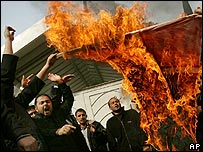 “Prints of the Danish cartoon depicting Islam‘s Prophet Mohammed as a suicide bomber in 2005 — much to the chagrin of the international Muslim community — will now be sold by the Denmark Free Press Society for $250 each. One thousand copies are to be printed and sold, with each having a designated number and signature by the artist, Kurt Westergaard, who has been in hiding due to numerous death threats. . . .
“The controversial cartoons caused riots throughout the Muslim world in early 2006, resulting in a number of deaths, property damage and a general wounding of diplomatic relations between east and west that has still not fully healed.” (more @ Huffington Post)
“Westergaard, 73, is one of 12 cartoonists whose drawings of the Muslim prophet were first published in Danish newspaper Jyllands-Posten in September 2005, sparking controversy among Muslims worldwide.” (more @ Straits Times)
Related
Posted in Collectors & Collecting, Europe, Humor, International Affairs, Magazines & Newspapers, Media & Advertising, Middle East, Politics, Popular Culture, Religion | Leave a Comment »
April 8, 2009 by jerrysmolin
 On Saturday, May 2nd, “The Millions.com” will lead their first annual “Walking Tour of New York’s Independent Bookstores.” The 11-stop itinerary begins in the East Village, continues through NoLita and SOHO, crosses the Brooklyn Bridge into DUMBO, and ends after 4 or so hours of walking and book-browsing in Williamsburg, Brooklyn.
The complete, 11-stop itinerary includes:
Additional information on the event can be found here.
A full-size Google map of the tour, with walking directions, can be found here.
Related: Literary DUMBO: An Afternoon Walk Under the Bridges in Search of Books
Posted in Books, Brooklyn, Business, DUMBO, Literature, New York City, U.S. Travel, Urban Affairs | Leave a Comment »
April 8, 2009 by jerrysmolin
 “One of Spain’s most enduring historical mysteries is close to being solved as experts decipher and translate more than 10,000 Arabic inscriptions adorning the walls of the Alhambra palace in Granada.
“The intricate Arabic inscriptions carved into the ceilings, columns and walls inside the imposing hill-top fortress have long fascinated visitors. They contain everything from snatches of poetry and verses from the Qur’an to clever aphorisms, pious wishes and boastful slogans.
“There are so many of them, however, that nobody has ever managed to study each and every one. Now a team of researchers armed with 3D laser scanners and digital imaging software is slowly working its way around the complex recording, transcribing and translating every inscription.
“‘There is probably no other place in the world where studying walls, columns and fountains is so similar to turning the pages of a book,’ said Juan Castilla, of Spain’s Higher Council for Scientific Research (CSIC), who heads the team.” (cont’d @ Guardian UK)
Posted in Archaeology, Architecture, Europe, Foreign Travel, Literature, Poets & Poetry, Religion, Science & Technology | Leave a Comment »
April 8, 2009 by jerrysmolin
 “Walgreens has announced that the commander in chief will not sprout a Chia Afro on its shelves. . . .
“We decided to pull the product because it didn’t fit with our corporate image,” [Robert Elfinger, a spokesman for Walgreens] said in a company statement. “We also didn’t want to be subject to any misinterpretation over the product. People could interpret it through a political viewpoint or other viewpoints and we want to avoid that situation.” . . .
“News of Walgreens’ removal of the presidential planter has led at least one enterprising Internet seller to offer the Chia Obama for $50—more than double the $19.99 shelf price.” (more @ Chicago Tribune)
Related
Posted in Business, Collectors & Collecting, Obama, Popular Culture, Race, Sign of the Apocalypse | Leave a Comment »
April 8, 2009 by jerrysmolin
 “In a recession, what people want is a happy ending.
“At a time when booksellers are struggling to lure readers, sales of romance novels are outstripping most other categories of books and giving some buoyancy to an otherwise sluggish market.
“Harlequin Enterprises, the queen of the romance world, reported that fourth-quarter earnings were up 32 percent over the same period a year earlier, and Donna Hayes, Harlequin’s chief executive, said that sales in the first quarter of this year remained very strong. While sales of adult fiction overall were basically flat last year, according to Nielsen Bookscan, which tracks about 70 percent of retail sales, the romance category was up 7 percent after holding fairly steady for the previous four years.” (more @ NY Times)
Related: That Old Flame
Posted in Books, Business, Economy, Popular Culture | Leave a Comment »
April 7, 2009 by jerrysmolin
 “Authorities in Sarajevo plan to name a city square after the late U.S. author and activist Susan Sontag, who, during the Bosnian war, staged Samuel Beckett’s Waiting for Godot there. . . .
“Sontag’s insistence on staging the existential play in the besieged city drew attention to the country’s civil war. The Washington Post dubbed Sontag’s production ‘Waiting for Clinton.’
“‘Beckett’s play, written over 40 years ago, seems written for, and about, Sarajevo,’ noted Sontag at the time.
“The writer died in 2004 at age 71 from leukemia.” (more @ CBC News)
Posted in Europe, International Affairs, Literature, Plays & Playwrights, Politics, Writers & Writing | Leave a Comment »
April 7, 2009 by jerrysmolin
 “A list of Jews saved from the Nazi death camps during World War II by the German industrialist Oskar Schindler has been found in research notes at an Australian library and will go on public display on Tuesday.
“The list of 801 Jewish men was found among six boxes of papers that belonged to the Australian author Thomas Keneally who wrote the book ‘Schindler’s Ark’ that was the basis for the Oscar-winning film ‘Schindler’s List‘ by Stephen Spielberg. The 13-page, yellowing, document was found tucked between research notes and German newspaper cuttings by a researcher at the New South Wales Library in Sydney sifting through the boxes of manuscripts acquired by the library in 1996.” (more @ Reuters)
Related: Schindler’s List found in Sydney
Posted in Books, Cinema, Crimes & Misdemeanors, Europe, International Affairs, Jewish Life, Museums & Exhibitions, Popular Culture, Religion, Writers & Writing | Leave a Comment »
April 7, 2009 by jerrysmolin
 “What’s the right price for an e-book? No more than $10, says a group of Amazon Kindle e-book owners — and they have found a novel way to make themselves heard.
“Some 250 Kindle readers are using Amazon’s own book-tagging system to mark e-books priced more than $10 with the tag ‘9 99 boycott‘. Their argument: A Kindle book is more restricted in its use than a paper book and therefore should not cost as much. . . .
“The protesters are the latest in a long line of consumers to rebel against restrictive copy-protection technologies. Music lovers have been circumventing copy protection for decades, leading some labels to begin removing digital rights management (DRM) technology entirely. Film studios and consumers have clashed over copy protection in DVDs. Even iPhone apps are not immune from DRM-busting pirates.” (more @ Wired)
Related: Pirates Board Apple’s iPhone App Store
Posted in Books, Business, Science & Technology | Leave a Comment »
April 6, 2009 by jerrysmolin
 “Robert Delford Brown, a painter, sculptor, performance artist and avant-garde philosopher whose exuberantly provocative works challenged orthodoxies of both the art world and the world at large, usually with a big wink, was found dead on March 24 in the Cape Fear River in Wilmington, N.C. . . .
“A colleague of artists like Jim Dine, Claes Oldenburg and Nam June Paik, Mr. Brown was a central figure in the anarchic New York art scene of the early 1960s, a participant in — and instigator of — events-as-art known as “happenings.” He saw the potential for aesthetic pronouncement in virtually everything. His métier was willful preposterousness, and his work contained both anger and insouciance.
“His raw materials included buildings, pornographic photos and even meat carcasses.
“He often performed in the persona of a religious leader, but dressed in a clown suit with a red nose and antennas hung with ripe bananas. In the end his message to the world was that both spirited individualism and unimpeded creativity must triumph.” (more @ NY Times)
Posted in Art & Artists, Counter Culture, New York City, Obituaries | Leave a Comment »
April 5, 2009 by jerrysmolin
 “Eric Segalstad has spent the past few years researching a group of musicians who have been dubbed ‘The 27s’ — rockers who died at that age, either through tragedy, misadventure or excess. The club includes Kurt Cobain, who took his own life 15 years ago Sunday.
“The king of grunge is just one of the more than 20 musicians featured in Segalstad’s book, The 27s: The Greatest Myth of Rock & Roll. It includes artists across all genres — from Jim Morrison to Robert Johnson.
“So, what is it about the number 27?
“‘It’s a strange number,’ Segalstad tells NPR’s Robert Smith. ‘It also happens right around that time in your life where most people go from the stage of youth to the stage of maturity.'” (more @ NPR)
An excerpt from Segalstad’s book can be found here.
Posted in Blues & Jazz, Counter Culture, Popular Culture, Popular Music, Rock 'n' Roll | Leave a Comment »
« Newer Posts - Older Posts »


 The 'Not-So-Rough' Guide