Feeds:
Posts
Comments

Archive for the ‘Popular Culture’ Category

Indonesia Miss Universe“A ‘relaxing, calm, beautiful place’ may not be everyone’s description of Guantanamo Bay, Cuba, where the United States holds about 240 prisoners in a detention center that has drawn condemnation from around the world.

“But this was the opinion of reigning Miss Universe Dayana Mendoza of Venezuela, who visited the U.S. naval facility in eastern Cuba this month . . .

“‘It was a loooot of fun!,’ Mendoza wrote . . . she said they also visited a bar on the base and the ‘unbelievable’ beach there.” (more @ Reuters)

UpdateMiss Universe’s Blog Post on Guantánamo Vanishes

Read Full Post »

Johnny Blanchard, a power-hitting catcher and outfielder known as Super Sub who played in five consecutive World Series for the Yankees in the 1960s, died Wednesday in Robbinsdale, Minn. He was 76. . . .

“As a left-handed hitter who could deliver the long ball, Blanchard seemed a perfect fit for Yankee Stadium and its short right-field fence. But he was essentially a catcher and had little chance of breaking into the starting lineup since the Yankees had Yogi Berra and Elston Howard.

“Blanchard’s best season was 1961, when he hit a career-high 21 home runs and batted .305 in 93 games. He was decidedly in the shadow of Roger Maris, who broke Babe Ruth’s record with 61 homers, and Mickey Mantle, who hit 54 home runs . . .” (more @ NY Times)

[Johnny Blanchard hit a home run in the first baseball game I ever attended. My father had taken me to a Sunday doubleheader at Yankee Stadium where I spent the entire first game waiting with glove in hand to catch a Mickey Mantle home run (we were sitting in foul territory behind third base but I was young and unwilling to give in to the territorial realities of a sport I was just beginning to understand). About mid-way through the second game, and having not yet caught a Mantle home run — no one other than Blanchard had connected for a homer all day — my father suggested we leave right then so we could beat the traffic leaving the stadium at game’s end. As he started up the car in the parking lot, the roar from the stadium behind us left little doubt of what had just happened – Mickey Mantle had hit a home run! It took me quite some time to forgive my father for ruining my chance to catch Mantle’s homer but I still remember fondly the Yankee whose home run I did witness that day – Johnny Blanchard. R.I.P.]

Read Full Post »

hemingwayhopkinsAnthony Hopkins will play Ernest Hemingway in an indie titled Hemingway & Fuentes, to be produced and directed by Andy Garcia. . . .

“Garcia, who also co-wrote the script with Hemingway’s niece, author Hilary Hemingway, will costar in the film as well, playing the real life fishing-boat captain Gregorio Fuentes, who befriended Papa Hemingway in the last decade of the alpha-male writer’s life. Fuentes was said to be the model for one of Hemingway’s most enduring literary creations: the grizzled fisherman Santiago in The Old Man and the Sea, which won the Pulitzer Prize in 1952.” (more @ Entertainment Weekly; via Books, Inq.)

Read Full Post »

kellGeorge Kell, the Hall of Fame third baseman who won the American League batting title in 1949 with the Detroit Tigers and was a longtime broadcaster for the team, died Tuesday at his home in Swifton, Ark. He was 86. . . .

“Kell played in the A.L. for 15 seasons, was an All-Star 10 times and had a career batting average of .306 with 2,054 hits. He hit at least .300 in nine seasons and led the league’s third basemen in fielding percentage seven times.

“He captured the batting crown in a race that went down to the final day of the 1949 season, finishing a few decimal points ahead of Ted Williams of the Boston Red Sox. Kell’s batting average was .34291 (rounded off to .343) to Williams’s .34276.” (more @ NY Times)

Read Full Post »

Paul Goldberger, architecture critic for The New Yorker magazine, on New York’s two new baseball stadiums, “the first time that two major-league stadiums have opened in the same city at the same time”:

“A stadium is a stage set as sure as anything on Broadway, and it determines the tone of the dramas within. Citi Field suggests a team that wants to be liked, even to the point of claiming some history that isn’t its own. Yankee Stadium, however, reflects an organization that is in the business of being admired, and is built to serve as a backdrop for the image of the Yankees, at once connected to the city and rising grandly above it.” (more @ The New Yorker)

RelatedTwo New Baseball Palaces, One Stoic, One Scrappy

Read Full Post »

Iconic albino, iconic assassin, iconic baby lotion, iconic brand, iconic bridge, iconic bucket, iconic building, iconic button fly, iconic camper van, iconic car, iconic cassoulet, iconic CCTV camera, iconic celebration, iconic chainsaw, iconic chair, iconic chef, iconic chimpanzee, iconic children’s entertainer, iconic clock, iconic cocktail, iconic comb, iconic combover, iconic comedy, iconic cooling tower, iconic Coventry City football shirt, iconic cricket bat, iconic crisps, iconic diaper, iconic doll, iconic dreadlocks, iconic drinker, iconic earthmover, iconic episode of “Emmerdale”, iconic escalator, iconic enema, iconic field armour, iconic film star, iconic fishing reel, iconic flat cap, iconic garden, iconic goggles, iconic gorilla, iconic grocery, iconic guitarist, iconic hairstyle, iconic halo, iconic hand cream, iconic handshake, iconic hanging laundry, iconic hazard, iconic helmet, iconic high heels, iconic hitman, iconic house, iconic ice cream, iconic icon, iconic injury, iconic injury-time winner, iconic itinerary, iconic jihad target, iconic jigsaw, iconic jingle, iconic jockey, iconic joke, iconic kitchen utensil, iconic knife, iconic knowledge, iconic lawnmower, iconic leprechaun, iconic light fitting, iconic lion, iconic lip balm, iconic mascara, iconic milkshake, iconic mittens, iconic moment, iconic moustache, iconic mouthwash, iconic movie, iconic murder, iconic noose, iconic ointment, iconic orangutan, iconic palace, iconic panda, iconic penis, iconic perfume, iconic philosophy, iconic photograph, iconic pig, iconic pimp, iconic piston, iconic playwright, iconic plumber, iconic pub, iconic pylon, iconic radiator, iconic relationship, iconic restaurant, iconic retail mall, iconic robot, iconic rodent, iconic saddle, iconic sandwich, iconic sausage, iconic shampoo, iconic shoe, iconic shoehorn, iconic shop, iconic silhouette, iconic snack food, iconic soft drink, iconic sound system, iconic steeplejack, iconic stethoscope, iconic submachinegun, iconic sunglasses, iconic surgeon, iconic taxi, iconic terrorist, iconic toaster, iconic toby jug, iconic toilet paper, iconic toilet seat, iconic tracksuit, iconic tractor, iconic treehouse, iconic trenchcoat, iconic typeface, iconic vending machine, iconic vindaloo, iconic wedding dress, iconic welder, iconic wheelchair, iconic wig, iconic wine, iconic yak, iconic yogurt, iconic zip hoodie. (more @ Intelligent Life)

Read Full Post »

wizardofozWas Dorothy in Frank Baum’s 1900 children’s novel The Wonderful Wizard of Oz a Populist “Everyman” who — with William Jennings Bryan (Lion), a farmer (Scarecrow) and an industrial worker (Tin Woodman) — went off to see the Wizard (President) to voice support for the use of silver as currency? Or, more critically, as economists today “fear an onset of deflation, and economic certainties melt away like a drenched wicked witch,” are there lessons to be learned from Oz?
“In 1964, high school teacher Henry Littlefield wrote an article outlining the notion of an underlying allegory in Frank Baum’s book. He said it offered a ‘gentle and friendly’ critique of Populist thinking, and the story could be used to illuminate the late 19th Century to students. . . .

“[Littlefield] believed the characters could represent the personalities and themes of the late 1800s, with Dorothy embodying the everyman American spirit.

“US political historian Quentin Taylor, who supports this interpretation, says: ‘There are too many instances of parallels with the political events of the time.’ . . .

“But not everyone believes The Wonderful Wizard of Oz includes any hidden meanings.

“‘Nobody ever suggested it until 1964,’ says Bradley Hansen, who is a professor of economics at the University of Mary Washington. ‘There’s no solid evidence that Baum had written it as a monetary allegory,’ he adds.”

As for the value of Baum’s book to present-day economists, Taylor agrees that despite the references to late 19th-century economic issues, “little can be learnt from Baum about the modern economic crisis.” (more @ BBC News)

RelatedSarah Palin As Dorothy? We’re Not In Kansas …

Read Full Post »

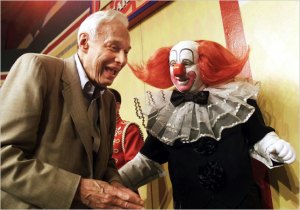
bozo“Alan W. Livingston, an entertainment executive who had significant roles in bringing Bozo, the Beatles and ‘Bonanza‘ to American audiences, died Friday at home in Beverly Hills. He was 91. . . .

“In 1963, Mr. Livingston was president of Capitol Records, which had declined three different times to release singles by a British band, then little known in the United States, called the Beatles. After another Capitol executive turned down a fourth opportunity, this one to release the song ‘I Want to Hold Your Hand,’ a telephone call placed to Mr. Livingston probably changed rock ‘n roll history. . . .

“Capitol released the single and the next year brought the Beatles to the United States, unleashing the tsunami of adoration that came to be known as Beatlemania.” (more @ NY Times)

Read Full Post »

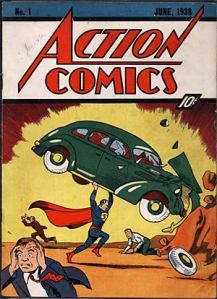
superman“A rare copy of the first comic book featuring Superman has sold for $317,200 in an Internet auction. . . .

The winning bid for the 1938 edition of Action Comics No. 1, whose cover features Superman lifting a car, was submitted Friday evening by John Dolmayan, drummer for the rock band System of a Down . . .

“Only about 100 copies of Action Comics No. 1 are known to exist.” (more @ LA Times)

Read Full Post »

viewmaster_red_with_reelFirst introduced at the 1939 World’s Fair in New York, “the iconic [View-Master] reels of tourist attractions, often packaged with a clunky plastic viewer and first sold to promote 3-D photography, are ending their 70-year run after years of diminishing sales. . . .

“Scenic discs are no longer a good fit for the Fisher-Price division of toy maker Mattel Inc., a spokeswoman said, and the company stopped making them in December. Fisher-Price, based in East Aurora, N.Y., will keep making better-selling reels of Shrek, Dora the Explorer and other animated characters, spokeswoman Juliette Reashor said in an e-mail to The Associated Press.” (more @ MSN)

Related

Read Full Post »

The full episode of last night’s The Daily Show featuring Jon Stewart‘s “interview” of CNBC’s Jim Cramer can be viewed here.

Related

UpdateRoubini: CNBC’s Jim Cramer A “Buffoon”

Read Full Post »

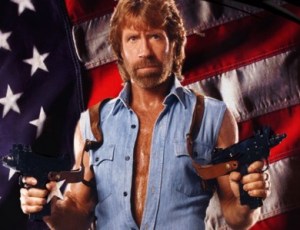
chcuk-norris“On Glenn Beck’s radio show last week, I quipped in response to our wayward federal government, ‘I may run for president of Texas.’

“That need may be a reality sooner than we think. If not me, someone someday may again be running for president of the Lone Star state, if the state of the union continues to turn into the enemy of the state. . . .

“Anyone who has been around Texas for any length of time knows exactly what we’d do if the going got rough in America. Let there be no doubt about that. As Sam Houston once said, ‘Texas has yet to learn submission to any oppression, come from what source it may.'” (more @ WorldNetDaily)

Read Full Post »

kerouacradioJack Kerouac, author of “On the Road” and progenitor of the Beat Generation as well as subsequent generations of literary dreamers, was born on this date in 1922 in Lowell, Massachusetts. He died in 1969 at age 47.

Gilbert Millstein’s 1957 New York Times review of “On the Road,” which Dwight Garner called “probably the most famous book review in the history of [the] newspaper,” can be found here.

The following excerpt from “On the Road” describes Sal Paradise’s (Kerouac’s) first attempt at traveling west alone:

I’d been poring over maps of the United States in Paterson for months, even reading books about the pioneers and savoring names like Platte and Cimarron and so on, and on the road-map was one long red line called Route 6 that led from the tip of Cape Cod clear to Ely, Nevada, and there dipped down to Los Angeles. I’ll just stay on all the way to Ely, I said to myself and confidently started. To get to 6 I had to go up to Bear Mountain. Filled with dreams of what I’d do in Chicago, in Denver, and then finally in San Fran, I took the Seventh Avenue Subway to the end of the line at 242nd Street, and there took a trolley into Yonkers; in downtown Yonkers I transferred to an outgoing trolley and went to the city limits on the east bank of the Hudson River. If you drop a rose in the Hudson River at its mysterious source in the Adirondacks, think of all the places it journeys as it goes to sea forever — think of that wonderful Hudson Valley. I started hitching up the thing. Five scattered rides took me to the desired Bear Mountain Bridge, where Route 6 arched in from New England. It began to rain in torrents when I was let off there. It was mountainous. Route 6 came over the river, wound around a traffic circle, and disappeared into the wilderness. Not only was there no traffic but the rain come down in buckets and I had no shelter. I had to run under some pines to take cover; this did no good; I began crying and swearing and socking myself on the head for being such a damn fool. I was forty miles north of New York; all the way up I’d been worried about the fact that on this, my big opening day, I was only moving north instead of the so-longed for west. Now I was stuck on my northermost hangup. I ran a quarter-mile to an abandoned cute English-style filling station and stood under the dripping eaves. High up over my head the great hairy Bear Mountain sent down thunderclaps that put the fear of God in me. All I could see were smoky trees and dismal wilderness rising to the skies. “What the hell am I doing up here?” I cursed, I cried for Chicago. “Even now they’re all having a big time, they’re doing this, I’m not there, when will I get there!” — and so on. Finally a car stopped at the empty filling station; the man and the two women in it wanted to study a map. I stepped right up and gestured in the rain; they consulted; I looked like a maniac, of course, with my hair all wet, my shoes sopping. My shoes, damn fool that I am, were Mexican huaraches, plantlike sieves not fit for the rainly night of America and the raw road night. But the people let me in and rode me back to Newburgh, which I accepted as a better alternative than being trapped in the Bear Mountain wilderness all night. “Besides,” said the man, “there’s no traffic passes through 6. If you want to go to Chicago you’d be better going across the Holland Tunnel in New York and head for Pittsburth,” and I knew he was right. It was my dream that screwed up, the stupid hearthside idea that it would be wonderful to follow one great red line across America instead of trying various roads and routes.

In Newburgh it had stopped raining. I walked down to the river and I had to ride back to New York in a bus with a delegation of schoolteachers coming back from a weekend in the mountains — chatter chatter blah-blah, and me swearing for all the time and money I’d wasted, and telling myself, I wanted to go west and here I’d been all day and into the night going up and down, north and south, like something that can’t get started. (via Literary Kicks)

Kerouac’s explanation of his “spontaneous prose” writing method can be found here.

Video and audio clips from Kerouac readings, as well as rare tapes of Kerouac and Neal Cassady, can be found here. More can be found here and here and here.

A video documentary, Jack Kerouac – King of the Beats, can be viewed here.

Related

Read Full Post »

colsanders540“A statue of Kentucky Fried Chicken’s Colonel Sanders tossed into Osaka’s Dotonbori River some 24 years ago by rowdy Hanshin Tigers fans has been discovered. . . .
“The Colonel ended up at the bottom of the river in 1985, when delirious Hanshin Tigers fans celebrating the team’s first Central League title in 21 years decided the figure bore a striking resemblance to Tigers slugger Randy Bass and, lifting it off its base in front of the Dotonbori Kentucky Fried Chicken franchise, gave the Colonel a victory toss. The fans put a little too much energy into the toss, and the Colonel Sanders figure went over the railing of the Ebisu Bridge and into the river. Since the statue’s victory dive into the Dotonbori, searches for the statue were undertaken, but none with any success.

“The Hanshin Tigers have not won the Japan Series since 1985, a fact attributed by some to the ‘Curse of Colonel Sanders.'” (more @ Mainichi Daily News; via Newser)

Read Full Post »

header1Mastro Auctions, responsible for the sale of over $250 million in sales since its inception in 1996, has ceased operations. 

“The suburban Chicago company’s assets have been taken over by a newly formed sports and Americana auction house, headed by former Mastro President and Chief Operating Officer Doug Allen, Vice President Ron Oser and Logistics and Auction Manager Mark Theotikos. The new company will be called Legendary Auctions. 

“Long-time collector/dealer Bill Mastro, who started Mastro Auctions in 1996 and served as Chairman and CEO, is leaving the hobby, according to a press release issued Tuesday night on behalf of Legendary Auctions. 

“‘Circumstances make it clear to me that the business needs to move in a different direction at this time,’ Mastro stated in the release. ‘Legendary Auctions is a positive step that allows everyone to be taken care of, especially our customers who have been so loyal. I am looking forward to taking some time off for now, and wish Legendary Auctions only the best as they move forward.'” (more @ Sports Collectors Daily)

Legendary Auction‘s Press Release announcing the acquisition of Mastro Auctions can be found here.

RelatedIs the Sports Collectibles Industry (or Mastro Auctions) on the Ropes?

Read Full Post »

cheers“For nearly 35 years, or almost half of his life, [Eddie] Doyle has been the smiling face behind the bar at Cheers – the Beacon Hill pub that inspired the TV show with the same name in the early 1980s. As one of Boston’s last fabled bartenders, he served drinks and advice for five decades. . . .

“But a few weeks ago he was told by Tom Kershaw, owner of the Cheers bar, that the recession had hit his industry and he was being laid off.  . . . As word spread of his layoff, many people, such as former Boston mayor Raymond Flynn, said that the city has lost an institution.

“‘He’s as important as George Washington to this city; he’s that well known,’ said Flynn. ‘The Cheers bar was internationally famous, but before it was internationally famous I think Eddie really brought them that notoriety and that attention. They say it’s a bar where everybody knows your name but it’s really a bar where everybody knows Eddie Doyle.'” (more @ Boston Globe)

Read Full Post »

306abboxlibraryBrooklyn, New York perfume merchant CB I Hate Perfume has just introduced “In the Library,” “a perfume inspired by the proprietor Christopher Brosius’s love of books and his inability to pass a secondhand bookshop without stopping in.

“According to the shop’s description, the perfume is supposed to evoke a first-edition English novel via ‘Russian and Moroccan leather bindings, worn cloth, and a hint of wood polish.'” (more @ The Book Bench)

[Makes me want to curl up with a good book . . . or a woman who smells like a good book!]

Read Full Post »

bukowskiCharles Bukowski died 15 years ago yesterday. During the early 1970s, I lived briefly in Denver, Colorado, where I imagined myself part of a “next wave” of beat writers working their way west from New York, via Denver, to Venice Beach in California. I panhandled on Colfax Avenue; I shoplifted groceries; I drank too much; I read my own poetry in bars for spare change; and from time to time, when I wasn’t imagining myself as Jack Kerouac, I imagined myself as Bukowski: I even wrote several poems in which I tried not just to channel his voice but to swallow the poet whole. One of my “Bukowski poems” is “published” here – about a woman who shrieked and stormed from the room during a reading I gave of a poem that mentioned a female body part. Following my poem are Bukowski’s “rules for writing.”

a conversation w/charles bukowski at the international house, denver

florence is wearing red lipstick,
sits with tired legs crossed,
handbag on lap.

“read a dirty poem!”

i hear bukowski
his mad eyes staring at me
through the window

i am introduced &
take my seat by the desk,
head hidden by the globe.

“read a dirty poem!”

bukowski has entered
unseen,
sits on my lap

“this is a filthy,
i mean,
erotic poem!”

he won’t let me speak

i become incensed,
roll my eyes &
tongue around the room.

florence returns my tongue,
pushes the globe aside
to see my face.
she asks me to read.

CUNT I SAY! CUNT! CUNT! CUNT!
THE CUNT IS HOLY: THE EYE OF GOD!

florence shows red teeth &
leaves through the window
with the globe.

bukowski smiles &
picks up my eyes.

(September, 1974)


so you want to be a writer?

if it doesn’t come bursting out of you
in spite of everything,
don’t do it.
unless it comes unasked out of your
heart and your mind and your mouth
and your gut,
don’t do it.
if you have to sit for hours
staring at your computer screen
or hunched over your
typewriter
searching for words,
don’t do it.
if you’re doing it for money or
fame,
don’t do it.
if you’re doing it because you want
women in your bed,
don’t do it.
if you have to sit there and
rewrite it again and again,
don’t do it.
if it’s hard work just thinking about doing it,
don’t do it.
if you’re trying to write like somebody
else,
forget about it.

if you have to wait for it to roar out of
you,
then wait patiently.
if it never does roar out of you,
do something else.

if you first have to read it to your wife
or your girlfriend or your boyfriend
or your parents or to anybody at all,
you’re not ready.

don’t be like so many writers,
don’t be like so many thousands of
people who call themselves writers,
don’t be dull and boring and
pretentious, don’t be consumed with self-
love.
the libraries of the world have
yawned themselves to
sleep
over your kind.
don’t add to that.
don’t do it.
unless it comes out of
your soul like a rocket,
unless being still would
drive you to madness or
suicide or murder,
don’t do it.
unless the sun inside you is
burning your gut,
don’t do it.

when it is truly time,
and if you have been chosen,
it will do it by
itself and it will keep on doing it
until you die or it dies in you.

there is no other way.

and there never was.

Read Full Post »

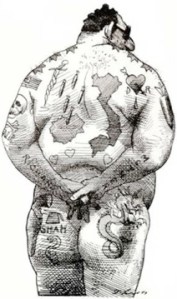
kissingercartoon“The Kissinger image [left] (by David Levine) is one of 320 illustrations – by 142 of the world’s most acclaimed contemporary artists – that The New York Times itself originally commissioned for its Op-Ed Pages, but then got cold feet about running, and eventually paid more than $1 million in ‘kill fees’ to hide from public view (sometimes for as long as 38 years).

“What didn’t the Times want you to see?

“Can you imagine illustrations so ‘blasphemous,’ so ‘politically embarrassing,’ so sexually ‘over the line’ that The New York Times gladly paid a fortune just to protect your delicate eyes from being exposed to them?

“You’ll find hundreds of such allegedly ‘not-fit-to-print’ illustrations – together with the bizarre and often ludicrous reasons for suppressing them – in a sly and deliciously funny new book called All The Art That’s Fit to Print (And Some That Wasn’t), by Jerelle Kraus, former Art Editor of the Times Op-Ed and Editorial Pages, who reluctantly quit her ‘dream job’ at the Times after 13 years in order to publish it. . . .

“Unfortunately, if you’re looking for more information about this book — don’t expect to consult a review in The New York Times. You won’t find one. For years the Times tried to discourage Ms Kraus from publishing this book, but now that it’s out, the Times is spitefully refusing even to acknowledge its existence, let alone actually review it. Since the Times‘ Book Section is a bible of the publishing world, not being noticed in its pages can often destroy a book’s chances of attracting a large audience.

“Which may be the the Times’s purpose — a publicity blackout might make the book quietly disappear.” (more @ AlterNet)

[Then there’s the New York Post, which had no problem running the Obama-as-stimulus-writing-monkey cartoon just last month. Seems to me both papers need to redraw their standards.]

Read Full Post »

shakespearebooksIn The Guardian, Jeanette Winterson, after a recent visit, recounts a bit of the history of Shakespeare and Company, Paris’ renowned Left Bank bookstore, first opened in 1913 and since 1962 owned by George Whitman. No visit to Paris is complete without a visit to this venerable literary institution which always recalls for me New York’s recently closed literary landmark, Gotham Book Mart 

“Way back, in 1913, the original Shakespeare and Company was opened by a young American called Sylvia Beach. Her shop in rue de l’Odéon soon became the place for all the English-speaking writers in Paris. Her lover, Adrienne Monnier, owned the French bookstore across the road, and she and Beach ran back and forth, finding penniless writers a place to stay, lending them books, arranging loans, taking their mail, sending their work to small magazines and, most spectacularly, publishing James Joyce’s Ulysses in 1922 when no one else would touch it.

“Hemingway was a regular at the shop, and writes about it in his memoir A Moveable Feast. . . . It was Hemingway, as a major in the US army, who at the liberation of Paris in 1945 drove his tank straight to the shuttered Shakespeare and Company and personally liberated Sylvia Beach. ‘No one that I ever knew was nicer to me,’ he said later, rich, famous and with a Nobel prize.

“But after the war, Beach was older and tired. She didn’t reopen the shop that had been forced into closure by the occupation. It was George Whitman who took over the spirit of what she had made, but not the name – until 1962, when Beach attended a reading by Lawrence Durrell at the bookstore and they all agreed that it should be renamed Shakespeare and Company.

“George took in the beat poets Allen Ginsberg and Gregory Corso. Henry Miller ate from the stewpot, but was too grand to sleep in the tiny writers’ room. Anaïs Nin left her will under George’s bed. There are signed photos from Rudolf Nureyev and Jackie Kennedy, signed copies of Jack Kerouac and William Burroughs.” (via Books, Inq.)

A New York Times article offering a brief history of Gotham Book Mart can be found here:

PHOTO: A December 1948 party at for Osbert and Edith Sitwell (seated, center) drew a roomful of bright lights to the Gotham Book Mart: clockwise from W. H. Auden, on the ladder at top right, were Elizabeth Bishop, Marianne Moore, Delmore Schwartz, Randall Jarrell, Charles Henri Ford (cross-legged, on the floor), William Rose Benét, Stephen Spender, Marya Zaturenska, Horace Gregory, Tennessee Williams, Richard Eberhart, Gore Vidal and José Garcia Villa. (Photo: Gotham Book Mart)

RelatedThe Gotham Book Mart’s Final Chapter?

Read Full Post »

« Newer Posts - Older Posts »