Feeds:
Posts
Comments

bukowskiCharles Bukowski died 15 years ago yesterday. During the early 1970s, I lived briefly in Denver, Colorado, where I imagined myself part of a “next wave” of beat writers working their way west from New York, via Denver, to Venice Beach in California. I panhandled on Colfax Avenue; I shoplifted groceries; I drank too much; I read my own poetry in bars for spare change; and from time to time, when I wasn’t imagining myself as Jack Kerouac, I imagined myself as Bukowski: I even wrote several poems in which I tried not just to channel his voice but to swallow the poet whole. One of my “Bukowski poems” is “published” here – about a woman who shrieked and stormed from the room during a reading I gave of a poem that mentioned a female body part. Following my poem are Bukowski’s “rules for writing.”

a conversation w/charles bukowski at the international house, denver

florence is wearing red lipstick,
sits with tired legs crossed,
handbag on lap.

“read a dirty poem!”

i hear bukowski
his mad eyes staring at me
through the window

i am introduced &
take my seat by the desk,
head hidden by the globe.

“read a dirty poem!”

bukowski has entered
unseen,
sits on my lap

“this is a filthy,
i mean,
erotic poem!”

he won’t let me speak

i become incensed,
roll my eyes &
tongue around the room.

florence returns my tongue,
pushes the globe aside
to see my face.
she asks me to read.

CUNT I SAY! CUNT! CUNT! CUNT!
THE CUNT IS HOLY: THE EYE OF GOD!

florence shows red teeth &
leaves through the window
with the globe.

bukowski smiles &
picks up my eyes.

(September, 1974)


so you want to be a writer?

if it doesn’t come bursting out of you
in spite of everything,
don’t do it.
unless it comes unasked out of your
heart and your mind and your mouth
and your gut,
don’t do it.
if you have to sit for hours
staring at your computer screen
or hunched over your
typewriter
searching for words,
don’t do it.
if you’re doing it for money or
fame,
don’t do it.
if you’re doing it because you want
women in your bed,
don’t do it.
if you have to sit there and
rewrite it again and again,
don’t do it.
if it’s hard work just thinking about doing it,
don’t do it.
if you’re trying to write like somebody
else,
forget about it.

if you have to wait for it to roar out of
you,
then wait patiently.
if it never does roar out of you,
do something else.

if you first have to read it to your wife
or your girlfriend or your boyfriend
or your parents or to anybody at all,
you’re not ready.

don’t be like so many writers,
don’t be like so many thousands of
people who call themselves writers,
don’t be dull and boring and
pretentious, don’t be consumed with self-
love.
the libraries of the world have
yawned themselves to
sleep
over your kind.
don’t add to that.
don’t do it.
unless it comes out of
your soul like a rocket,
unless being still would
drive you to madness or
suicide or murder,
don’t do it.
unless the sun inside you is
burning your gut,
don’t do it.

when it is truly time,
and if you have been chosen,
it will do it by
itself and it will keep on doing it
until you die or it dies in you.

there is no other way.
and there never was.

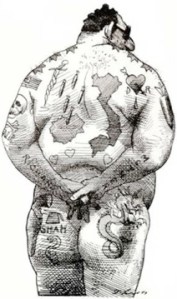
kissingercartoon“The Kissinger image [left] (by David Levine) is one of 320 illustrations – by 142 of the world’s most acclaimed contemporary artists – that The New York Times itself originally commissioned for its Op-Ed Pages, but then got cold feet about running, and eventually paid more than $1 million in ‘kill fees’ to hide from public view (sometimes for as long as 38 years).

“What didn’t the Times want you to see?

“Can you imagine illustrations so ‘blasphemous,’ so ‘politically embarrassing,’ so sexually ‘over the line’ that The New York Times gladly paid a fortune just to protect your delicate eyes from being exposed to them?

“You’ll find hundreds of such allegedly ‘not-fit-to-print’ illustrations – together with the bizarre and often ludicrous reasons for suppressing them – in a sly and deliciously funny new book called All The Art That’s Fit to Print (And Some That Wasn’t), by Jerelle Kraus, former Art Editor of the Times Op-Ed and Editorial Pages, who reluctantly quit her ‘dream job’ at the Times after 13 years in order to publish it. . . .

“Unfortunately, if you’re looking for more information about this book — don’t expect to consult a review in The New York Times. You won’t find one. For years the Times tried to discourage Ms Kraus from publishing this book, but now that it’s out, the Times is spitefully refusing even to acknowledge its existence, let alone actually review it. Since the Times‘ Book Section is a bible of the publishing world, not being noticed in its pages can often destroy a book’s chances of attracting a large audience.

“Which may be the the Times’s purpose — a publicity blackout might make the book quietly disappear.” (more @ AlterNet)

[Then there’s the New York Post, which had no problem running the Obama-as-stimulus-writing-monkey cartoon just last month. Seems to me both papers need to redraw their standards.]

“While Times Square is not known for star gazing — the celestial kind, that is — and few people would normally venture onto a pitch-black ball field in Inwood to see the constellations, two unrelated, if not unlikely, projects hope to turn the city’s night eyes skyward.

Jason Kendall, an amateur astronomer, and Katja Aglert, a Swedish installation artist, want to turn out the lights in different parts of Manhattan and, weather permitting, illuminate the night sky. . . .

“Mr. Kendall and Ms. Aglert, 38 — who do not know each other — face daunting challenges to realize their visions.

“He must persuade the city’s parks department to darken Inwood’s Dyckman Fields, which run north for about 15 blocks from Dyckman Street, on April 3 and April 4.

“She has to persuade landlords and billboard owners in Times Square to cut their lights for one minute sometime this spring. . . .

“On the nights in April that Mr. Kendall wants Dyckman Fields darkened, the moon will rise early, and astronomy enthusiasts around the world are signifying the occurrence to commemorate the 400th anniversary of Galileo’s first recorded use of a telescope. . . .

“Ms. Aglert, who was awarded $21,000 from the Swedish government and given office space by the Lower Manhattan Cultural Council to pursue her project, faces fewer government hurdles than Mr. Kendall. Since she is not proposing to turn off traffic signals, street lamps and other city lights, she does not need official approval, though the Buildings Department said she had to submit a proposal.” (more @ NY Times)

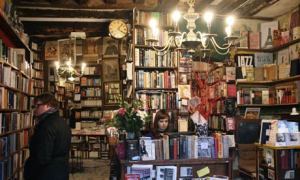
shakespearebooksIn The Guardian, Jeanette Winterson, after a recent visit, recounts a bit of the history of Shakespeare and Company, Paris’ renowned Left Bank bookstore, first opened in 1913 and since 1962 owned by George Whitman. No visit to Paris is complete without a visit to this venerable literary institution which always recalls for me New York’s recently closed literary landmark, Gotham Book Mart 

“Way back, in 1913, the original Shakespeare and Company was opened by a young American called Sylvia Beach. Her shop in rue de l’Odéon soon became the place for all the English-speaking writers in Paris. Her lover, Adrienne Monnier, owned the French bookstore across the road, and she and Beach ran back and forth, finding penniless writers a place to stay, lending them books, arranging loans, taking their mail, sending their work to small magazines and, most spectacularly, publishing James Joyce’s Ulysses in 1922 when no one else would touch it.

“Hemingway was a regular at the shop, and writes about it in his memoir A Moveable Feast. . . . It was Hemingway, as a major in the US army, who at the liberation of Paris in 1945 drove his tank straight to the shuttered Shakespeare and Company and personally liberated Sylvia Beach. ‘No one that I ever knew was nicer to me,’ he said later, rich, famous and with a Nobel prize.

“But after the war, Beach was older and tired. She didn’t reopen the shop that had been forced into closure by the occupation. It was George Whitman who took over the spirit of what she had made, but not the name – until 1962, when Beach attended a reading by Lawrence Durrell at the bookstore and they all agreed that it should be renamed Shakespeare and Company.

“George took in the beat poets Allen Ginsberg and Gregory Corso. Henry Miller ate from the stewpot, but was too grand to sleep in the tiny writers’ room. Anaïs Nin left her will under George’s bed. There are signed photos from Rudolf Nureyev and Jackie Kennedy, signed copies of Jack Kerouac and William Burroughs.” (via Books, Inq.)

A New York Times article offering a brief history of Gotham Book Mart can be found here:

PHOTO: A December 1948 party at for Osbert and Edith Sitwell (seated, center) drew a roomful of bright lights to the Gotham Book Mart: clockwise from W. H. Auden, on the ladder at top right, were Elizabeth Bishop, Marianne Moore, Delmore Schwartz, Randall Jarrell, Charles Henri Ford (cross-legged, on the floor), William Rose Benét, Stephen Spender, Marya Zaturenska, Horace Gregory, Tennessee Williams, Richard Eberhart, Gore Vidal and José Garcia Villa. (Photo: Gotham Book Mart)

RelatedThe Gotham Book Mart’s Final Chapter?

“It opened nearly three years ago at an army drill hall in Edinburgh and has toured the world from New York to Sydney. But the play Black Watch only reached London last year – allowing it entry to the UK’s most prestigious theatre awards. Last night it walked away with four.

“The National Theatre of Scotland‘s story of the now amalgamated regiment came away with the most Olivier awards for an individual production, including best new play and, for John Tiffany, best director. . . . An unforgettable play based on interviews with soldiers who served in Iraq, it also won for sound design and choreography.” (more @ The Guardian)

A complete list of 2009 Olivier Award winners can be found here.

The New York Times review from the first of Black Watch‘s two runs at St. Ann’s Warehouse in Brooklyn (2007) can be found here.

Related

[As much as I admire Black Watch — which I saw during both of its New York runs — I was disappointed that Tracy Letts’s August: Osage County, which I also attended twice, and which won both the 2008 Tony Award for Best Play and the 2008 Pulitzer Prize for Drama, did not win the Olivier best new play award. My sense is that the war-tested Scottish regiment enjoyed a bit of a home field advantage in London over Letts’s dysfunctional and hard-drinking Oklahoma family.]

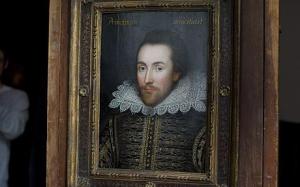
PD*27420284“Professor Stanley Wells, Chairman of The Shakespeare Birthplace Trust, and one of the world’s leading experts on Shakespearean studies, today announced the discovery of a portrait of William Shakespeare, which he believes is almost certainly the only authentic image of Shakespeare made from life.

“The newly discovered picture has descended for centuries in the same family, the Cobbes. It hung in their Irish home, under another identification, until the 1980s, when it was inherited by Alec Cobbe who was a co-heir of the Cobbe estate and whose heirlooms were transferred into a trust. In 2006 Alec Cobbe visited the National Portrait Gallery exhibition ‘Searching for Shakespeare’ where he saw a painting that now hangs in the Folger Shakespeare Library, Washington. It had been accepted as a life portrait of Shakespeare until some 70 years ago, but fell from grace when it was found to have been altered. Mr Cobbe immediately realised that this was a copy of the painting in his family collection. . . .

“Up to now only two images have been accepted as authentic representations of what Shakespeare may have looked like. One is the engraving by Martin Droeshout published in the First Folio of 1623. The other is the portrait bust in Holy Trinity Church, Stratford-upon-Avon; the monument is mentioned in the Folio and therefore must have been in place by 1623. Both are posthumous – Shakespeare died in 1616. The engraver, who was only in his teens when Shakespeare died, must have had a picture, until now unidentified, to work from. Professor Wells believes it to be the one he has revealed today and that it was done from life, in about 1610, when he was 46 years old.” 

The portrait will be on exhibit at the Shakespeare Birthplace Trust in Stratford-upon-Avon beginning April 23 (which may be both the anniversary of his birth in 1564 and of his death in 1616). (via NY Times)

A video report on the painting’s discovery was featured on the CBS News “Early Show” and can be found here.

Related

UpdateShakespeare Unfound(ed)?

greer-funniersexGermaine Greer, author of the 1970 “feminist” classic, “The Female Eunuch,” on whether men are the funnier sex:

“The greater visibility of male comedians reflects a greater investment of intellectual energy by men of all walks of life in keeping each other amused. It is now a truism that men never talk to each other about things that matter. Most of what takes place when men are together is phatic communication, intended to build fellowship rather than intimacy. This kind of communication is sometimes derided by women as meaningless, but it is actually functional, because it draws the group together. Men who drink, play and joke together are boon companions, who hang together for fun. He laughs loudest who laughs last; one joke kicks off another. The man who cannot hold his own in repartee will even learn other men’s jokes off by heart, so that he can fill a void in the general banter. Women famously cannot learn jokes. If they try, they invariably bugger up the punchline. The male teller of jokes is driving towards his reward, the laughter of his mates. The woman who messes up the same joke does so because her concentration is not sharpened by that need. She is not less intelligent, simply less concerned.”

That said, “Given an opportunity to perform a finished comedy routine, a female comedian will make you laugh as hard as any man.” (more @ The Guardian)

RelatedMen can ‘laugh women into bed’ with GSOH, say psychologists

obama-bushFrom an opinion piece by Jackson Diehl, deputy editor of The Washington Post‘s editorial page, suggesting that Obama may be more comparable to George W. Bush than Franklin Roosevelt:

“So Obama hasn’t strayed far from Karl Rove’s playbook for routing the opposition. But surely, you say, he’s planning nothing as divisive or as risky as the Iraq war? Well, that’s where the health-care plan comes in: a $634 billion (to begin) ‘historic commitment,’ as Obama calls it, that (like the removal of Saddam Hussein) has lurked in the background of the national agenda for years.”

[Forgive me, but I’m having a little trouble accepting a comparison between an illegal war that continues to cost countless billions of dollars and thousands upon thousands of lives, both American and Iraqi, with plans to reform the U.S. health care system, no matter how expensive. There’s more to fume about in Diehl’s piece but I think this gets my point across.]

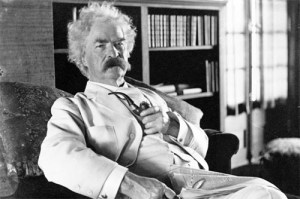
marktwain“Almost 99 years after his death on April 21, 1910, Mark Twain will publish a new short story next week in the pages of the quarterly mystery magazine the Strand.

“Discovered in Twain’s archive — reportedly the largest collection of personal papers left behind by a 19th century American author — the never-before-published ‘The Undertaker’s Tale’ is a short tale-within-a-tale about a wretched homeless boy who is taken in by a kindly undertaker’s family. . . .

“‘The Undertaker’s Story’ will be part of a new book, ‘Who Is Mark Twain?,’ that is due out next month. It’s the first collection of his unpublished short works and will include 24 stories and essays.” (via LA Times)

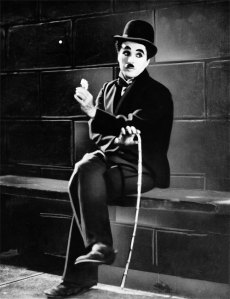
citylightsFrom The Nation archives, reviews of a dozen vintage films reflecting “the hardships and aspirations of Americans in the first Great Depression”:

books“In Woody Allen’s clever 1983 mockumentary ‘Zelig,’ the title character lies about having read ‘Moby-Dick’ so he can fit in with the crowd – kicking off a career as a face-changing human chameleon.

“Turns out there are a lot of Zeligs around: a recent survey found that more than two-thirds of respondents admitted to lying about having read classic books, with George Orwell’s ‘1984’ topping the fib list.

“The survey of more than 1,300 readers by the UK-based organizers of World Book Day, placed Leo Tolstoy’s ‘War and Peace’ and James Joyce’s ‘Ulysses’ at Nos. 2 and 3 of the book that inspired the most lies.

“Breaking at least one commandment, 24 percent of those surveyed said they had lied about reading The Bible, which placed No 4. People didn’t only pretend to read old-time tomes: President Obama’s ‘Dreams from My Father’ made the list, at No. 9.” (more @ NBC New York)

colognes-historical-archi-001

“For the best part of a decade, the heirs of German writer and Nobel prize laureate Heinrich Böll worked on hammering out a deal with the city of Cologne over the transfer of his private papers to the state archives.

“Three weeks ago, city officials held a special ceremony to mark the historic handover: for €800,000 (£712,000), the Cologne archives took possession of hundreds of boxes containing items ranging from Böll’s school reports to scripts of his radio plays, novels and essays by Germany’s most popular post-second world war writer, who died in 1985 at the age of 67.

“But his papers and unpublished works may have been lost for ever after the collapse of the archives building this week. . . .

“The Böll documents are just a small part of the losses to the archives which contained almost 30km of files, including articles written by Karl Marx, letters by Georg Hegel, writings by composer Jacques Offenbach and edicts issued by Napoleon Bonaparte, as well as the minutes of city council meetings going back to 1376, which offer a fascinating portrait of medieval Cologne.” (more @ The Guardian)

A video of the post collapse excavations can be viewed here. (via Books, Inq.)

digestReader’s Digest Association Inc., the closely held magazine publisher, hired law firm Kirkland & Ellis LLP to explore restructuring options including a possible bankruptcy filing, a person familiar with the situation said.” (via Bloomberg)

[While I have never been a reader of the Digest, and have always scoffed at their library of “condensed books,” Reader’s Digest was my father’s magazine of choice — my father-in-law still swears by it — as well as a ubiquitous presence in every doctor’s and dentist’s waiting room visited during my childhood.]

mcewanFrom Daniel Zalewski’s admiring essay on Ian McEwan, “England’s national author”:

“McEwan is a connoisseur of dread, performing the literary equivalent of turning on the tub faucet and leaving the room; the flood is foreseeable, but it still shocks when the water rushes over the edge. That’s how it is with the hounds that descend upon a woman in the 1992 novel ‘Black Dogs’; the orgiastic murder in the 1981 novel ‘The Comfort of Strangers’; the botched sexual initiation in ‘On Chesil Beach.’ At moments of peak intensity, McEwan slows time down—a form of torture that readers enjoy despite themselves. In ‘The Child in Time,’ from 1987, a man’s little girl is kidnapped at the supermarket, and his rising panic is charted with the merciless precision of a cardiogram. In ‘The Innocent,’ a 1990 tale of espionage in postwar Berlin, McEwan spends eight pages conjuring a corpse’s dismemberment. And ‘Saturday’ keeps the reader jangled for nearly forty pages, wondering along with Perowne if an airplane descending on London has become a terrorist missile. Martin Amis says, ‘Ian’s terribly good at stressed states. There’s a bit of Conrad that reminds me of Ian. It’s ‘Typhoon,’ when the captain is heading into this terrible storm and Conrad is in the position of first mate. Going into the captain’s cabin, he notices that the ship is yawing so that the captain’s shoes are rolling this way and that across the floor, like two puppies playing with each other. You think, Wow, to keep your eyes open when most people would be closing theirs. Ian has that. He’s unflinching.’

“Page-turning excitement has long been a suspect virtue in a literary novel, and some critics have disparaged McEwan as a hack with elegant prose. He does lean on noirish tropes—the climaxes of ‘Enduring Love’ and ‘Saturday’ both involve a deranged man, a trembling woman, and a knife. But McEwan believes that something stirring should happen in a novel. Though he is animated by ideas, he would never plop two characters on a sofa and have them expound rival philosophies. The opening to ‘Enduring Love’ offers a crisp illustration of game theory: when a balloon becomes untethered, each of the five men holding a rope is forced to make a decision without knowing what the others will do. But most readers enjoy it as a thrilling set piece. On our walk, McEwan twice cited Henry James’s dictum that the only obligation of a novel ‘is that it be interesting.’ Later, McEwan declared that he finds ‘most novels incredibly boring. It’s amazing how the form endures. Not being boring is quite a challenge.'” (more @ The New Yorker)

RelatedJames Wood writes about the manipulations of Ian McEwan

[McEwan’s essay “On John Updike” in The New York Review of Books, in which he describes Updike as having been as “troubled by science as others are troubled by God,” can be found here.]

Obama 2008“Joe the Plumber” is suing former Ohio officials for violating his privacy, reports the Cleveland Plain Dealer. Employees of the state’s family services department (since resigned) checked Samuel Wurzelbacher for unpaid child support obligations, after Sen. John McCain elevated him to prominence. “You shouldn’t have to regret asking a reasonable question in a public forum of a presidential candidate,’ says the head of the group representing Wurzelbacher.

“Wurzelbacher says this is just one example of how the campaign caused long-term damage to his reputation. ‘I can no longer actually work as a plumber,’ he told the Washington Post. That’s because anything he does—like break a pipe—would become national news. ‘I’ve spoken to some of my plumbing buddies in town and no one really wants to touch me right now.'” (via Newser)

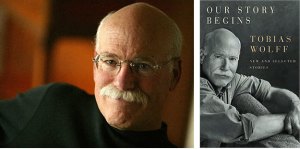
tobias_wolffOn Wednesday night, shortly after reading from his well-known story ‘Bullet in the Brain,’ Tobias Wolff was called back to the stage of the New School’s Tishman Auditorium to accept The Story Prize. The other two finalists were Jhumpa Lahiri’s best-selling Unaccustomed Earth (Knopf) and Joe Meno’s Demons in the Spring (Akashic Books). . . . The $20,000 award Wolff received, in addition to an engraved silver bowl, is the largest first-prize amount of any annual U.S. book award for fiction.” (via Reuters)

RelatedWhat Wolff knows

hogsberg_5

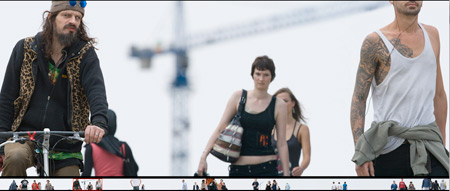
From photographer Simon Høgsberg, a new work, We’re All Going To Die – 100 Meters of Existence, shot from the same spot over the course of 20 days during the summer of 2007, features 178 people walking across a railroad bridge on Warschauer Strasse in Berlin. One hundred meters wide, the image is scene in panels that progress by scrolling, or sliding, along the bottom of the main panel.

Also from Germany, another set of interactive photographs, “Naked People,” offers a revealing look at 24 German men and women of varying sizes, ages and occupations, whose clothing vanishes with a click of the mouse. By my admittedly loose translation, the project asserts that clothing, broadly accepted as a social signifier, offers only illusion, telling us little or nothing about a person’s true character. Finally, by confronting us — after a mouse-click — with the person now undressed, the project asks if even unclothed an individual’s character remains unfathomable. (Both series via The Daily Dish)

bobguskindBob Guskind, the legendary Brooklyn blogger and founder of Gowanus Lounge, has died:
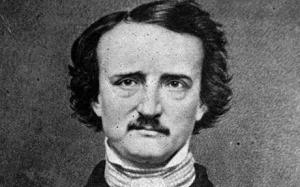
“After days of speculation inside and outside the blogosphere, much-liked journalist Robert Guskind died on Wednesday, the city Medical Examiner confirmed this morning. . . .

“In his prime, Guskind’s blog focussed a keen eye on city development projects with an objectivity and a level of reporting rare in the blog world.” (via The Brooklyn Paper)

The following video of Bob Guskind is via newyorkshitty, a blog about Greenpoint, Brooklyn:

Vodpod videos no longer available.

Memorials to Guskind on other Brooklyn blogs can be found at: Dumbo NYC, Only the Blog Knows Brooklyn.

Guskind’s “flikr” photostream, featuring numerous sets of Brooklyn neighborhoods, can be found here.

Flatbush Gardener is maintaining a running list of online tributes to Guskind. The list gets longer by the hour.

PD*5068633Edgar Allan Poe apologizes to his publishers for drinking too much and asks them to buy an article because he’s ‘desperately pushed for money’ in an 1842 letter acquired by the University of Virginia for an exhibition marking the author’s 200th birthday. . . .

“‘Will you be so kind enough to put the best possible interpretation upon my behaviour while in N-York?,’ Poe asks New York publishers J. and Henry G. Langley. ‘You must have conceived a queer idea of me — but the simple truth is that Wallace would insist upon the juleps, and I knew not what I was either doing or saying.’ . . .

“The U.Va. Library released the letter this week ahead of an exhibit opening Saturday that highlights Poe’s enduring literary works, brief life and mysterious death at the age of 40. Poe attended the Charlottesville university, but had to drop out after less than a year in part because of financial difficulties, which plagued him the rest of his life.” (via Associated Press)

nea“Unemployment rates are up among working artists and the artist workforce has contracted, according to new research from the National Endowment for the Arts.  Artists in a Year of Recession: Impact on Jobs in 2008 examines how the economic slowdown has affected the nation’s working artists.  The study looks at artist employment patterns during two spikes in the current recession – the fourth quarters of 2007 and 2008.  This downturn reflects larger economic declines: a Commerce Department report last week noted a 6.2 percent decrease in the gross domestic product in the last quarter of 2008.

“Among the findings:

  • Artists are unemployed at twice the rate of professional workers
  • Unemployment rates for artists have risen more rapidly than for U.S. workers as a whole
  • Artist unemployment rates would be even higher if not for the large number of artists leaving the workforce
  • Unemployment rose for most types of artist occupations
  • The job market for artists is unlikely to improve until long after the U.S. economy starts to recover” (via mediabistro)