Feeds:
Posts
Comments

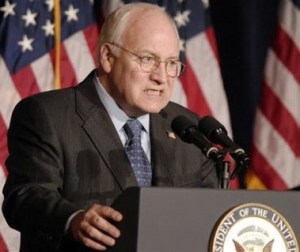
cheney-panicAndrew Sullivan wonders, “Is Cheney Panicking?”:

“The one thing you saw most plainly in the Plame affair is how obsessed Dick Cheney is with public image, the chattering classes and spinning stories that might reflect poorly on him. The act is the elder statesman, authoritatively reviewing the world scene, soberly making judgments, calmly explaining it later to those pesky people who are required to elect you every four years. The reality is a man who lost it on 9/11, leapt immediately to apocalyptic conclusions, and then, as the dust cleared, was unable to go back on the war crimes he had authorized and so dug in ever more deeply to justify them. I don’t think anyone begrudges that kind of misjudgment at the beginning, although one would have hoped for calmer heads in a crisis, but the attempt to institutionalize the torture of first resort into an entire program of black sites, torture manuals, Orwellian euphemisms, and legal fantasy was bound, like the institutionalization of Gitmo, to collapse under any successor who actually wanted to return the US to the rule of law and the world of civilized nations.

“Did Cheney believe he could hide all this for ever?

“Did he believe that hundreds of randomly seized human beings could be consigned to the black hole of Gitmo for ever? And was he really going to launch this kind of appalling attacks on his successors whenever they tried to move past this stuff or be forced, by the law itself and the Geneva Conventions, to investigate and prosecute violations of core human rights?

“The ratcheting up of the rhetoric – ‘I think you have to be very careful. The world outside there — both our friends and our foes — will be quick to take advantage of a situation if they think they’re dealing with a weak president or one who’s not going to stand up and aggressively defend America’s interests’ – is particularly Weimar. He’s lashing out now, and using his surrogates to write chilling op-eds defending all of it. I see this as a sign of weakness, not strength. Obama draws these people out like moths to the flame.

“That flame is the truth. Let us see it all.”

Related
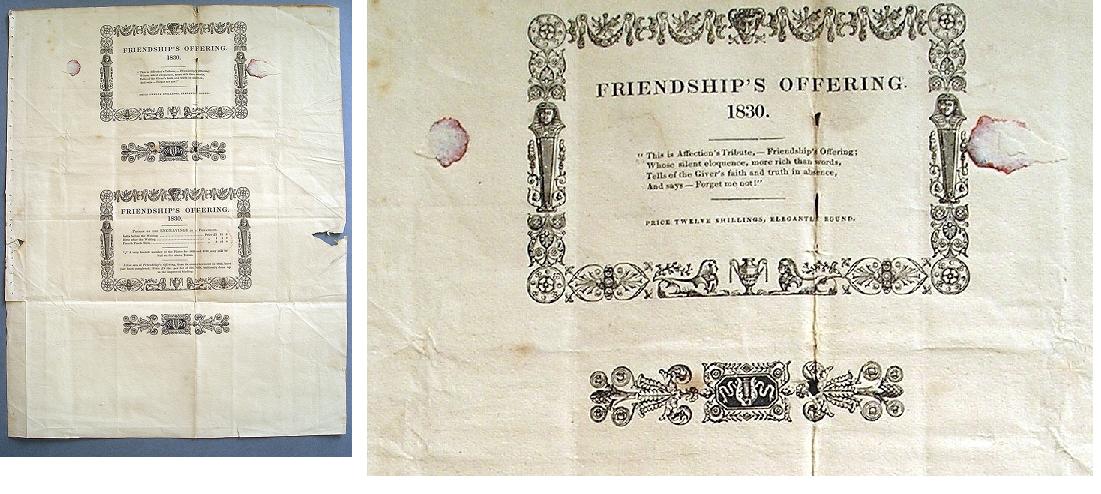
1829-dust-jacket“A librarian digging through the archives at the Bodleian Library, University of Oxford has found the earliest known example of a publisher’s dust jacket. The dust jacket, which had been separated from the book it was created for, was found bound with other booktrade ephemera. (Click image to enlarge)

“It belonged to: Friendship’s Offering for 1830. London: Smith, Elder, & Co., 1829.” (more @ Seattle Post-Intelligencer

More information on 19th century dust jackets (including the former earliest known jacket issued in 1832) can be found at 19th Century Dust Jackets.

hopper-new-york-restaurantJoseph Epstein on why New York food is so good:

“Manhattan must have 300, perhaps 400, splendid restaurants. I estimate that Chicago has, at the outside, 30, and San Francisco, Los Angeles and Washington, D.C., respectively probably not more than that. Why is this? How to account for this plentitude of good restaurant food in Manhattan?

“Demand has a lot to do with it. By this I don’t mean demand as in the old economists’ formula of supply and demand. What I mean is that New Yorkers are, and always have been, more demanding than any other Americans when it comes to what they eat. . . .

“New Yorkers tend to order food as if they are spoiled children dining in their mothers’ kitchens. They demand excellent service, which includes accommodation for their idiosyncrasies (that pickle on the separate plate). If they do not get what they want, they howl, return food, do not return to the restaurant, and verbally torch the place. If you open a restaurant in New York, you had better be good, or you will soon be gone.” (more @ Wall Street Journal)

[Thanks, John.]

“During the late Thirties, some of Britain’s most distinguished architects, artists, musicians, film-makers and others, many of them Jewish, arrived on our shores with their meagre belongings having escaped from the Nazi threat in continental Europe. Many of them made their homes here and went on to leave a lasting mark on our intellectual and cultural life. Britain reaped a rich reward for its tolerance. . . .

“Among them were two refugees from Vienna, Walter Neurath and Eva Feuchtwang. . . .

“They met in London during the war, fell in love, and in 1949, 60 years ago, they pooled their passions, and set up a new art publishing imprint that would straddle the Atlantic.

“They named it Thames & Hudson, after the rivers of London and New York, and their aim was to publish reasonably priced books on art, sculpture and architecture, in which words and pictures were integrated and accessible to all. They wanted their books to educate, inform and entertain as a ‘museum without walls’. . . .

“Setting out to rebuild British culture Thames & Hudson has grown into a hugely successful company, and it remains one of Britain’s last family-held publishing dynasties.” (more @ Times Online)

“Nearly a decade ago, embarrassed about reports of widespread fraud in the $1-billion-per-year sports memorabilia industry — dominated by baseball and filled mostly with fakes and forgeries, according to an F.B.I. investigation — Major League Baseball did something about it.

“Now every game has at least one authenticator, watching from a dugout or near one. The authenticators are part of a team of 120 active and retired law-enforcement officials sharing the duties for the 30 franchises. Several worked the home openers for the Yankees and the Mets, helping track firsts at the new stadiums. They verified balls, bases, jerseys, the pitchers’ rosin bag, even the pitching rubber and the home plate that were removed after the first game at Yankee Stadium.

“Nothing is too mundane to be authenticated, if deemed potentially valuable. Cans of insect repellent used to combat the midges that swarmed the 2007 playoffs in Cleveland were authenticated. So were urinals pulled from the old Busch Stadium in St. Louis and office equipment from since-razed Veterans Stadium in Philadelphia. The Phillies are cutting the clubhouse carpet from last season into authenticated 18-by-24-inch mats. . . .

“Authenticators carry rolls of high-tech hologram stickers. A bullet-shaped one is placed on the object. Removing it leaves polka dots of the decal attached and renders the removed sticker unusable. A second sticker, with a matching number and a bar code, is scanned by a hand-held unit, instantly recording the item into M.L.B. computers.” (more @ NY Times)

Whatever the future holds for printed books, this much is certain: there is no shortage of ink being spilled presently by writers offering their visions of the digital future –

In “How the E-Book Will Change the Way We Read and Write,” author Steven Johnson points to two key developments, “the breakthrough success of Amazon’s Kindle e-book reader, and the maturation of the Google Book Search service,” and proposes that “2009 may well prove to be the most significant year in the evolution of the book since Gutenberg hammered out his original Bible.” (more @ Wall Street Journal)

Related: The Social Dilemma of e-Reading

“On inauguration day, Tom Brokaw was moved to compare Barack Obama’s election to Czechoslovakia’s 1989 Velvet Revolution. At the eye of each storm, of course, was an icon who merged the political and the aesthetic–Václav Havel, the rock-star poet and prophet, and Barack Obama, the post-soul master of his own story. Both struck down eras of monocultural repression with their pens.

“Artists played a largely unheralded role in Obama’s victory. But they had been tugging the national unconscious forward for decades, from the multiculturalist avant-gardes of the 1970s and ’80s to the hip-hop rebels of the ’90s and 2000s, plying a fearless, sometimes even unruly kind of polyculturalism. By the final months of the election season, these artists had secured Obama as the waking image of change.

“Every moment of major social change requires a collective leap of imagination. Political transformation must be accompanied not just by spontaneous and organized expressions of unrest and risk but by an explosion of mass creativity. Little wonder that two of the most maligned jobs during the forty years after Richard Nixon’s 1968 election sealed the backlash of the ‘silent majority‘ were community organizer and artist.

“Obama was both. So why haven’t community organizers and artists been offered a greater role in the national recovery?” (cont’d @ The Nation)

killingfieldHolocaust deniers aside, the world is not ignorant of the systematic Nazi slaughter of some six million Jews in World War II. People know of the gas chambers in Auschwitz and Bergen-Belsen; many have heard of the tens of thousands shot dead in the Ukrainian ravine of Babi Yar. But little has been known about the hundreds — perhaps thousands — of smaller killing fields across the former Soviet Union where some 1.5 million Jews met their deaths.

“That is now changing. Over the past few years, the Yad Vashem Holocaust museum and research center in Israel has been investigating those sites, comparing Soviet, German, local and Jewish accounts, cross-checking numbers and methods. The work, gathered under the title ‘The Untold Stories,’ is far from over. But to honor Holocaust Remembrance Day, which starts Monday evening, the research is being made public on the institution’s Web site.” (more @ NY Times)

The presence of many lethal genetic diseases affecting the brain among Ashkenazi Jews may also increase their intelligence – so say Gregory Cochran (bottom), a physicist and genetics buff, and geneticist Henry Harpending (top), authors of the recently published, The 10,000 Year Explosion: How Civilization Accelerated Human Evolution.

From the Los Angeles Times:

“The biological basis for intelligence can be a thankless arena of inquiry. The authors of ‘The Bell Curve’ were vilified 15 years ago for suggesting genes played a role in IQ differences among racial groups.

“But Cochran, 55, and Harpending, 65, say there’s no question that as a whole, Ashkenazi Jews — those of European descent — have an abundance of brain power. (Neither man is Jewish.)

“Psychologists and educational researchers have pegged their average IQ at 107.5 to 115. That’s only modestly higher than the overall European average of 100, but the gap is large enough to produce a huge difference in the proportion of geniuses. When a group’s average IQ is 100, the percentage of people above 140 is 0.4%; when the average is 110, the genius rate is 2.3%.

“Though Jews make up less than 3% of the U.S. population, they have won more than 25% of the Nobel Prizes awarded to American scientists since 1950, account for 20% of this country’s chief executives and make up 22% of Ivy League students, the pair write.” (more @ LA Times)

RelatedAre Jews Smarter?

baseball-lingoWhere would pols, pundits and morose mucky-mucks be without the language of baseball?

“Here’s the pitch: Despite distractions, you have to keep your eye on the ball. You have to be aware of something unexpected coming out of left field, and only if your ad-libbed response is not off base will your home team go to bat for you. You can’t be born on third base and think you hit a triple. Last year, candidate Obama took the sting out of criticism by the scribes for playing ball with a Chicago fixer by admitting, right off the bat, that his property purchase was boneheaded. Palin showed she had something on the ball, considered 2008 a warm-up in the bullpen and took a rain check for 2012, when she hopes to knock the ball out of the park, unless she gets thrown a curve by the rise of Romney, now in the catbird’s seat.” (more @ NY Times)

rossetFrom NPR, a profile of publisher Barney Rosset, former owner of Grove Press and The Evergreen Review, in advance of the publication of his autobiography, The Subject Is Left Handed, which takes its name from his FBI file. The article includes a clip from Obscene,” a film biography (2007) of Rosset, in which Rosset discusses acquiring Samuel Beckett‘s Waiting for Godot.

“Independent publisher Barney Rosset was there for some of the most important — and controversial — developments in 20th century American literary history. The first to publish Samuel Beckett in the United States, Rosset has been honored by the National Book Foundation, the Association of American Publishers and the French Ministry of Culture.

“Born to a wealthy Chicago banker, Rosset served as a photographer in World War II and afterward tried his hand at filmmaking and writing before buying a small, nearly defunct publishing company named Grove Press in 1951. . . .

“Rosset knew nothing about the business of publishing, but one of the first books Grove put out in 1954 became one of its most important: Waiting for Godot, by Samuel Beckett. . . .

“Over the years Grove did have a couple of best-sellers, including A Confederacy of Dunces, by John Kennedy Toole and Games People Play, by Eric Bern. And Grove championed the avant garde and politically inflammatory. It published the work of noted 20th century playwrights like Eugene Ionesco, Harold Pinter, Tom Stoppard and David Mamet, as well as The Autobiography of Malcolm X, which had been dropped by Doubleday.

“In 1957 Grove Press got into magazine publishing; The Evergreen Review became one of the most important magazines of the counterculture . . . Two years after launching The Evergreen Review, Rosset stepped into the national headlines when he decided that Grove would publish Lawrence’s novel Lady Chatterley’s Lover, which other American publishers had shunned because of its frank sexuality. After the postal service impounded more than a hundred copies of the book, Rosset went to court claiming it was protected under the First Amendment. He won, but that was only part of his strategy. His real goal, Rosset says, was to publish another banned book: Henry Miller’s 1934 autobiographical novel, Tropic of Cancer.” (more @ NPR)

Related

[INTERVIEWER: Didn’t you say somewhere, “I am for obscenity and against pornography”?

MILLER: Well, it’s very simple. The obscene would be the forthright, and pornography would be the roundabout. I believe in saying the truth, coming out with it cold, shocking if necessary, not disguising it. In other words, obscenity is a cleansing process, whereas pornography only adds to the murk.]

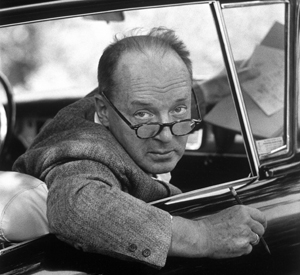
nabokov“Penguin is to publish Vladimir Nabokov‘s unfinished final novel, The Original of Laura. Penguin Classics editor Alexis Kirschbaum bought the book, together with continuing rights to the Nabokov backlist, in a six-figure deal through Andrew Wylie. The Original of Laura will be published as a Penguin Classics hardback at £25 on 3rd November, and simultaneously by Knopf in the US.

“Nabokov left the novel unfinished when he died in 1977, asking for it to be destroyed. His son Dimitri Nabokov finally took the decision to publish, bearing in mind that his father once also intended to burn his best-known work, Lolita. . . .

“The novel is narrated by a man who, when young, fell obsessively in love with a young girl, but who is now unhappily married to a promiscuous wife with whom he is infatuated. Kirschbaum said the book was both dark and comic, and continued the theme of nostalgia for young love begun in Mary and continued in Lolita and Ada.” (more @ The Bookseller)

andrew-sullivan“Andrew Sullivan’s story is inherently implausible. How did an HIV-positive gay Catholic conservative from the poky English town of East Grinstead end up as one of the most powerful writers in America?
“Today his blog, the Daily Dish, is regularly named as one of the most influential in America, and in November it reached 23m hits in the month. Politicians from Condoleezza Rice to Barack Obama himself have courted Sullivan in the hope of friendly posts. After he moved his blog to the website of the venerable Atlantic Monthly magazine, the traffic there rose by 30%.

“This is all the stranger since—unlike other big-name bloggers such as the liberal-Democratic Markos Moulitsas of the Daily Kos or the libertarian Republican Glenn Reynolds of Instapundit — he has no obvious political constituency. Sullivan is regarded by his critics as an attention-deficit bundle of contradictions. He is a conservative Christian who rages against the self-proclaimed forces of conservative Christianity. He is a pioneering crusader for gay marriage savaged by the gay left as ‘chief faggot’, herding homosexuals on behalf of The Patriarchy. He admits: ‘I’m very uncomfortable with audiences who agree with me… I’ve never really had a place where someone didn’t dispute my right to be there.’ So what is the glue that holds together the blogger-king?” (cont’d @ Intelligent Life)

bigburger“Last week, the West Michigan Whitecaps minor league baseball team sold more than 100 mega-sized burgers on opening night.

“It’s made with five patties plus chili, American cheese, nacho cheese, tortilla chips, salsa, lettuce, tomato and sour cream — all piled on an 8-inch bun.

“The mammoth meal weighs more than 4 pounds. And, even in this era of scaling back, plenty of people took on the burger by themselves.

“This monster of a burger is called the Fifth Third burger. It has five 1/3-pound patties of beef.” (cont’d @ NPR)

A video of the burger being prepared can be viewed here.

[Click on image to “supersize.”]

Judith F. Krug, who led the campaign by libraries against efforts to ban books, including helping found Banned Books Week, then fought laws and regulations to limit children’s access to the Internet, died Saturday in Evanston, Ill. She was 69. . . .

“As the American Library Association’s official proponent of the First Amendment’s guarantee of free speech since the 1960s, Ms. Krug (pronounced kroog) fought the banning of books, including ‘Huckleberry Finn,’ ‘Mein Kampf,’ ‘Little Black Sambo,’ ‘Catcher in the Rye’ and sex manuals. In 1982, she helped found Banned Books Week, an annual event that includes authors reading from prohibited books.

“She also fought for the inclusion of literature on library shelves that she herself found offensive, like ‘The Blue Book’ of the ultraconservative John Birch Society. The book is a transcript of a two-day monologue by Robert Welch at the founding meeting of the society in 1958.

“‘My personal proclivities have nothing to do with how I react as a librarian,’ Ms. Krug said in an interview with The New York Times in 1972. ‘Library service in this country should be based on the concept of intellectual freedom, of providing all pertinent information so a reader can make decisions for himself.’ (cont’d @ NY Times)

05_Flatbed_1 - APRIL“Mexico is protesting what it says is a whopper of an insult.
An advertisement for Burger King‘s Texican Whopper burger that has run in Europe shows a small wrestler dressed in a cape resembling a Mexican flag. The wrestler teams up with a lanky American cowboy almost twice his height to illustrate the cross-border blend of flavors.

“‘The taste of Texas with a little spicy Mexican,’ a narrator’s voice says.

“The taller cowboy boosts the wrestler up to reach high shelves and helps clean tall windows, while the Mexican helps the cowboy open a jar.

“Mexico’s ambassador to Spain said Monday he has written a letter to Burger King’s offices in that nation objecting to the ad and asking that it be removed. Jorge Zermeno told Radio Formula that the ads ‘improperly use the stereotyped image of a Mexican.'” (more @ NY Daily News)

evesedgwickEve Kosofsky Sedgwick died in New York yesterday, at the age of fifty-nine, following a long battle with breast cancer. The literary critic, who taught most recently at the CUNY Graduate Center, is best known for her formative work in the field of queer theory (in the books ‘Between Men’ and ‘Epistemology of the Closet’), including a number of provocative — and often scandalous — readings of classic literary texts. In the nineteen-eighties and nineties, her visibility as a member of Duke University’s English Department placed her at the forefront of the culture wars, but her largely symbolic role in those conflicts meant that criticism of her work seldom did justice to the subtlety and searing wit of her writing, nor to her sensitivity to the social and sexual bonds that tie us to each other and to the world.” (more @ The New Yorker)

RelatedEve Kosofsky Sedgwick, a Pioneer of Gay Studies and a Literary Theorist, Dies at 58

fidrychMark Fidrych, an eccentric All-Star pitcher nicknamed ‘The Bird’ whose career was shortened by injuries, was found dead Monday in an apparent accident at his farm. He was 54. . . .

“The curly-haired right-hander was the American League Rookie of the Year in 1976 when he went 19-9 with a 2.34 ERA and 24 complete games. He spent all five of his major league seasons with the Detroit Tigers, compiling a 29-19 record and a 3.10 ERA. . . .

“Fidrych acquired the nickname ‘The Bird’ because of his resemblance to the Big Bird character on the Sesame Street television show. During games, he would bend down and groom the mound with his hands, talk to the baseball and slap five with teammates in the middle of the diamond.” (more @ ESPN)

RelatedIn ’76, Bird was the word

kurt-vonnegutKurt Vonnegut’s longtime publisher, Delacorte Press, has announced it will issue 14 never-before published short stories by the author, who died in 2007, in a new collection, Look at the Birdie, slated for publication in November 2009. . . .

Look at the Birdie will include original Vonnegut illustrations and a foreword by Sidney Offit, a longtime Vonnegut confidant and the current curator of the George Polk Awards in Journalism. Bantam Dell publisher and editor-in-chief Nita Taublib and editor Kerri Buckley put the collection together. Taublib said, ‘Considered independently, these are 14 exceptionally intricate short pieces by an author whose voice we miss immensely. Taken together, they give the reader a clear sense of Kurt Vonnegut’s development into one of the most beloved and original American writers of all time.'” (more @ Publishers Weekly)

bannedbooks“‘American Psycho’ is Bret Easton Ellis’ story of a sadistic murderer. ‘Unfriendly Fire’ is a well-reviewed empirical analysis of military policy. But it’s ‘Unfriendly Fire’ that does not have a sales rank — which means it would not show up in Amazon’s bestseller lists, even if it sold more copies than the ‘Twilight’ series. In some cases, being de-ranked also means being removed from Amazon’s search results.

“Amazon’s policy of removing ‘adult’ content from its rankings seems to be both new and unevenly implemented. . . .

“Our research shows that these books have lost their ranking: ‘Running with Scissors’ by Augusten Burroughs, ‘Rubyfruit Jungle’ by Rita Mae Brown, ‘Fun Home: A Family Tragicomic’ by Alison Bechdel, ‘The History of Sexuality, Vol. 1’ by Michel Foucault, ‘Bastard Out of Carolina’ by Dorothy Allison (2005 Plume edition), ‘Little Birds: Erotica’ by Anais Nin, ‘The Diving Bell and the Butterfly’ by Jean-Dominque Bauby (1997 Knopf edition), ‘Maurice’ by E.M. Forster (2005 W.W. Norton edition) and ‘Becoming a Man’ by Paul Monette, which won the 1992 National Book Award.

“Books that remain ranked include: ‘Naked’ by David Sedaris, ‘Tropic of Cancer’ by Henry Miller, ‘American Psycho’ by Bret Easton Ellis, ‘Wifey’ by Judy Blume, ‘The Kiss’ by Kathryn Harrison, the photobooks ‘Playboy: Helmut Newton’ and ‘Playboy: Six Decades of Centerfolds,’ ‘Naked Lunch’ by William Burroughs, ‘Incest: From ‘A Journal of Love” by Anais Nin, ‘The Diving Bell and the Butterfly’ by Jean-Dominque Bauby (2007 Vintage International edition), ‘Maurice’ by E.M. Forster (2005 Penguin Classics edition). . . .

“But as troubling as the unevenness of the policy of un-ranking and de-searching certain titles might be, it’s a bit beside the point. It’s the action itself that is troubling: making books harder to find, or keeping them off bestseller lists on the basis of their content can’t be a good idea.” (more @ LA Times)

Related

Update