Feeds:
Posts
Comments

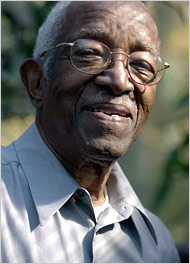
John Hope Franklin, a prolific scholar of African-American history who profoundly influenced thinking about slavery and Reconstruction while helping to further the civil rights struggle, died Wednesday in Durham, N.C. He was 94. . . .

“During a career of scholarship, teaching and advocacy that spanned more than 70 years, Dr. Franklin was deeply involved in the painful debates that helped reshape America’s racial identity, working with the Rev. Dr. Martin Luther King Jr., W. E. B. Du BoisThurgood Marshall and other major civil rights figures of the 20th century. . . .

“Dr. Franklin combined idealism with rigorous research, producing such classic works as ‘From Slavery to Freedom: A History of African-Americans,’ first published in 1947. Considered one of the definitive historical surveys of the American black experience, it has sold more than three million copies and has been translated into Japanese, German, French, Chinese and other languages. . . .

“Dr. Franklin also taught at some of the nation’s leading institutions, including Harvard and the University of Chicago in addition to Duke, and as a scholar he personally broke several racial barriers.” (more @ NY Times)

RelatedJohn Hope Franklin, Scholar and Witness

[During my brief time as an undergraduate in 1970-71 at York College in Jamaica, New York, I was a double-major in English and the relatively new academic discipline, African-American Studies. While my interest in books and reading was derived from my uncle, the first member of our family to earn a college degree and whose library of literary classics and contemporary sociology lined a wall in my grandparents’ apartment, my interest in “Black Studies” was in part a protest against my father whose ambivalence about civil rights despite working for twenty years as a salesman in a men’s clothing store on 125th Street in Harlem frustrated my make-love-not-war/power-to-the-people counter-culturalist sensibilities. John Hope Franklin’s From Slavery to Freedom was required reading for my freshman Afro-Am 101 class. But while I respected Franklin’s long view of history, I was much more excited by my readings of Eldridge Cleaver, Amiri Baraka (the former LeRoi Jones), Stokely Carmichael and other black writers who spoke forcefully of the need for political and social change “now.” So struck was I by the writings of these powerful black voices that when I first became eligible to vote, I tried, albeit in vain, to register as a member of the Black Panther Party (my consolation, the only reasonable choice if I intended to vote, was to register as an Independent). Twenty years later, when as a graduate student at Yale University (in neither English nor African American studies) I reconsidered some of my freshman readings in cultural studies, it was Franklin’s books — exemplars of fair-minded scholarship and idealism — that mattered most in the then and “now.” R.I.P.]

“Short, lucid writing is needed in these uncertain times, according to the Booker prize-winning Nigerian author Ben Okri, who is releasing a new poem line by line on Twitter. . . .

“‘I sing a new freedom,’ Okri Twittered yesterday, following it up today with the second line of the poem, ‘Freedom with discipline’, today. The poem was written to mark the release of Okri’s new book, Tales of Freedom, in April. The book brings together short stories and poetry in what Okri’s publisher described as ‘a fascinating new form, using writing and image pared down to their essentials, where haiku and story meet’. The entire poem will be posted on Okri’s Facebook and MySpace pages once it is completed.” (more @ The Guardian)

Johnny Blanchard, a power-hitting catcher and outfielder known as Super Sub who played in five consecutive World Series for the Yankees in the 1960s, died Wednesday in Robbinsdale, Minn. He was 76. . . .

“As a left-handed hitter who could deliver the long ball, Blanchard seemed a perfect fit for Yankee Stadium and its short right-field fence. But he was essentially a catcher and had little chance of breaking into the starting lineup since the Yankees had Yogi Berra and Elston Howard.

“Blanchard’s best season was 1961, when he hit a career-high 21 home runs and batted .305 in 93 games. He was decidedly in the shadow of Roger Maris, who broke Babe Ruth’s record with 61 homers, and Mickey Mantle, who hit 54 home runs . . .” (more @ NY Times)

[Johnny Blanchard hit a home run in the first baseball game I ever attended. My father had taken me to a Sunday doubleheader at Yankee Stadium where I spent the entire first game waiting with glove in hand to catch a Mickey Mantle home run (we were sitting in foul territory behind third base but I was young and unwilling to give in to the territorial realities of a sport I was just beginning to understand). About mid-way through the second game, and having not yet caught a Mantle home run — no one other than Blanchard had connected for a homer all day — my father suggested we leave right then so we could beat the traffic leaving the stadium at game’s end. As he started up the car in the parking lot, the roar from the stadium behind us left little doubt of what had just happened – Mickey Mantle had hit a home run! It took me quite some time to forgive my father for ruining my chance to catch Mantle’s homer but I still remember fondly the Yankee whose home run I did witness that day – Johnny Blanchard. R.I.P.]

hemingwayhopkinsAnthony Hopkins will play Ernest Hemingway in an indie titled Hemingway & Fuentes, to be produced and directed by Andy Garcia. . . .

“Garcia, who also co-wrote the script with Hemingway’s niece, author Hilary Hemingway, will costar in the film as well, playing the real life fishing-boat captain Gregorio Fuentes, who befriended Papa Hemingway in the last decade of the alpha-male writer’s life. Fuentes was said to be the model for one of Hemingway’s most enduring literary creations: the grizzled fisherman Santiago in The Old Man and the Sea, which won the Pulitzer Prize in 1952.” (more @ Entertainment Weekly; via Books, Inq.)

“This month, a 33-year-old Belgian artist has started a project called I Got a Postcard, where people leave self-addressed stamped postcards that encourage the people who find them to personalize and mail them.

“Two weeks ago, he left his first 100 cards in 10 locations in New York City — including a library, airport, theater and bus — and waited for them to return. The cards read: ‘Dear finder, personalize this postcard and then return it to me. Be as original and artistic as possible and your creation will be submitted to igotapostcard.blogspot.com.’

“The artist, Renaud Dehareng (the artist name of Jason Burns), says he was inspired by PostSecret. And Postsecret itself was inspired by Found magazine.” (more @ NY Times)

Timely advice from Matt Gross, the New York Times’ “Frugal Traveler,” for “Staying in Touch Internationally, on the Cheap” using SkypeIn and SkypeOut with iPhones or unlocked cell phones.

RelatedAs Airfares Fall, Save Even After Buying

Update: Frugal Traveler: Skype Midterm Report

On the same day the New York Times reported that the city’s yellow cab industry is being spared from the worst effects of the recession by allowing riders to pay by credit card, the MTA announced major fare hikes for public transportation commuters:

“After a fiery hearing Wednesday, the Metropolitan Transportation Authority voted 12 to 1 to approve subway, bus and commuter train fare hikes from 25% to 30% and impose severe service cuts, including elimination of two subway lines and 21 local bus routes. . . .

“Starting May 31, the monthly MetroCard, now $81, will cost $103 and a weekly MetroCard, now $25, will cost $31. The one-way bus and subway fare will rise from $2 to $2.50, a whopping 25% increase.

“Commuter train fares rise June 1, while MTA bridge and tunnel tolls jump July 11. Service cuts also include longer gaps between trains and the closure of a few stations overnight.” (more @ The Daily News)

kellGeorge Kell, the Hall of Fame third baseman who won the American League batting title in 1949 with the Detroit Tigers and was a longtime broadcaster for the team, died Tuesday at his home in Swifton, Ark. He was 86. . . .

“Kell played in the A.L. for 15 seasons, was an All-Star 10 times and had a career batting average of .306 with 2,054 hits. He hit at least .300 in nine seasons and led the league’s third basemen in fielding percentage seven times.

“He captured the batting crown in a race that went down to the final day of the 1949 season, finishing a few decimal points ahead of Ted Williams of the Boston Red Sox. Kell’s batting average was .34291 (rounded off to .343) to Williams’s .34276.” (more @ NY Times)

“Sana Krasikov is the 2009 recipient of the $100,000 Sami Rohr Prize for Jewish Literature for emerging writers of Jewish literature. Krasikov wins the Prize for her debut short story collection, One More Year (Spiegel & Grau) . . . 

“The Sami Rohr Prize is the largest monetary prize of its kind in the Jewish literary world, and one of the largest literary prizes worldwide. In 2006, in celebration of Sami Rohr’s 80th birthday, his children and grandchildren inaugurated the Sami Rohr Prize to honor his lifelong love of Jewish literature. The Prize considers fiction and non-fiction in alternating years.” (more @ Jewish Book Council)

Wall built from gravestone fragments, Remu Shul (Synagogue) cemetary, Kraków, Poland.

The Remu [also: Rema, Remuh] synagogue (acronym for Rabbi Moses Isserles) is located in Kazimierz, the Jewish quarter of Krakow, and was founded in 1553 by Israel Isserles.  The Remu was considered to be the ‘Maimonides of Polish Jewry’ and was known for his universal outlook, his extensive Talmudic and secular knowledge, his manner of study, and his humility. . . .

“The adjacent Remu cemetery was used until 1799, and contains the graves of the Remu and his family. . . . After [World War II], the cemetery was restored and pieces of broken headstones which could not be matched were used to make a memorial cemetery wall.” (more @ New Cracow Friendship Society; Full photo; May, 2008)

I’ll not be posting to the NSRG this weekend when I’ll be visiting Washington, D.C. in order to view, in advance of my May trip to Naples, the exhibition, “Pompeii and the Roman Villa: Art and Culture Around the Bay of Naples,” at the National Gallery of Art. The exhibition, which includes recent discoveries on view in the United States for the first time, as well as finds from excavations dating to the mid-18th century, closes this Sunday. 

The New York Times review of the exhibition can be found here.

A slideshow, “The Treasures of Pompeii,” can be found here.

“On the eve of national strikes, the French have found a new way to show their dislike of [President] Nicolas Sarkozy: by reading a 17th century tale of thwarted love that the president has said he hates.

“Mr Sarkozy, a man often ridiculed in France for preferring fitness to literature, has frequently expressed his disdain for ‘La Princesse de Cleves (The Princess of Cleves), a novel by Madame de La Fayette which was published in 1678 and is taught in most French classrooms.

“Now, French readers have adopted the book as a symbol of dissent: as Mr Sarkozy’s popularity falls, sales of the book are rising.

“At the Paris book fair this week, publishers reported selling all available copies of the novel, while badges emblazoned with the slogan ‘I am reading La Princesse de Cleves’ were a must-have item that sold out within hours. . . .

“Public readings of the work have proliferated at universities like the Sorbonne in Paris, hit by protests over government reform plans, and at theatres.” (more @ Daily Telegraph UK)

Related

Paul Goldberger, architecture critic for The New Yorker magazine, on New York’s two new baseball stadiums, “the first time that two major-league stadiums have opened in the same city at the same time”:

“A stadium is a stage set as sure as anything on Broadway, and it determines the tone of the dramas within. Citi Field suggests a team that wants to be liked, even to the point of claiming some history that isn’t its own. Yankee Stadium, however, reflects an organization that is in the business of being admired, and is built to serve as a backdrop for the image of the Yankees, at once connected to the city and rising grandly above it.” (more @ The New Yorker)

RelatedTwo New Baseball Palaces, One Stoic, One Scrappy

“There’s now a rumored-price tag on George W. Bush‘s forthcoming memoirs, ‘Decision Points:’ a $7 million advance from publisher Crown. How does that stack up to other Deciders?

“It’s $5 million less than Bill Clinton‘s advance for My Life$1 million less than Hillary Clinton got for Living History, and $2 million less than the advance for the memoirs of Tony Friggin’ Blair, the British prime minister who answered to some queen, and to George W. Bush. BURN.” (via Gawker)

Related

bookerprize“The Man Booker International Prize was announced in June 2004 and recognises one writer for his or her achievement in fiction. Worth £60,000 to the winner, the prize is awarded once every two years to a living author who has published fiction either originally in English or whose work is generally available in translation in the English language. In addition, there is a separate prize for translation and, if applicable, the winner can choose a translator of his or her work into English to receive a prize of £15,000. . . .

“The Man Booker International Prize differs from the annual Man Booker Prize for Fiction in that it highlights one writer’s continued creativity, development and overall contribution to fiction on the world stage.  Both prizes strive to recognise and reward the finest fiction.”

The 14 authors on the 2009 contenders list are:

Previous winners of the prize are Ismail Kadare of Albania and Nigerian author Chinua Achebe. (more @ Man Booker Prizes)

Iconic albino, iconic assassin, iconic baby lotion, iconic brand, iconic bridge, iconic bucket, iconic building, iconic button fly, iconic camper van, iconic car, iconic cassoulet, iconic CCTV camera, iconic celebration, iconic chainsaw, iconic chair, iconic chef, iconic chimpanzee, iconic children’s entertainer, iconic clock, iconic cocktail, iconic comb, iconic combover, iconic comedy, iconic cooling tower, iconic Coventry City football shirt, iconic cricket bat, iconic crisps, iconic diaper, iconic doll, iconic dreadlocks, iconic drinker, iconic earthmover, iconic episode of “Emmerdale”, iconic escalator, iconic enema, iconic field armour, iconic film star, iconic fishing reel, iconic flat cap, iconic garden, iconic goggles, iconic gorilla, iconic grocery, iconic guitarist, iconic hairstyle, iconic halo, iconic hand cream, iconic handshake, iconic hanging laundry, iconic hazard, iconic helmet, iconic high heels, iconic hitman, iconic house, iconic ice cream, iconic icon, iconic injury, iconic injury-time winner, iconic itinerary, iconic jihad target, iconic jigsaw, iconic jingle, iconic jockey, iconic joke, iconic kitchen utensil, iconic knife, iconic knowledge, iconic lawnmower, iconic leprechaun, iconic light fitting, iconic lion, iconic lip balm, iconic mascara, iconic milkshake, iconic mittens, iconic moment, iconic moustache, iconic mouthwash, iconic movie, iconic murder, iconic noose, iconic ointment, iconic orangutan, iconic palace, iconic panda, iconic penis, iconic perfume, iconic philosophy, iconic photograph, iconic pig, iconic pimp, iconic piston, iconic playwright, iconic plumber, iconic pub, iconic pylon, iconic radiator, iconic relationship, iconic restaurant, iconic retail mall, iconic robot, iconic rodent, iconic saddle, iconic sandwich, iconic sausage, iconic shampoo, iconic shoe, iconic shoehorn, iconic shop, iconic silhouette, iconic snack food, iconic soft drink, iconic sound system, iconic steeplejack, iconic stethoscope, iconic submachinegun, iconic sunglasses, iconic surgeon, iconic taxi, iconic terrorist, iconic toaster, iconic toby jug, iconic toilet paper, iconic toilet seat, iconic tracksuit, iconic tractor, iconic treehouse, iconic trenchcoat, iconic typeface, iconic vending machine, iconic vindaloo, iconic wedding dress, iconic welder, iconic wheelchair, iconic wig, iconic wine, iconic yak, iconic yogurt, iconic zip hoodie. (more @ Intelligent Life)

wizardofozWas Dorothy in Frank Baum’s 1900 children’s novel The Wonderful Wizard of Oz a Populist “Everyman” who — with William Jennings Bryan (Lion), a farmer (Scarecrow) and an industrial worker (Tin Woodman) — went off to see the Wizard (President) to voice support for the use of silver as currency? Or, more critically, as economists today “fear an onset of deflation, and economic certainties melt away like a drenched wicked witch,” are there lessons to be learned from Oz?
“In 1964, high school teacher Henry Littlefield wrote an article outlining the notion of an underlying allegory in Frank Baum’s book. He said it offered a ‘gentle and friendly’ critique of Populist thinking, and the story could be used to illuminate the late 19th Century to students. . . .

“[Littlefield] believed the characters could represent the personalities and themes of the late 1800s, with Dorothy embodying the everyman American spirit.

“US political historian Quentin Taylor, who supports this interpretation, says: ‘There are too many instances of parallels with the political events of the time.’ . . .

“But not everyone believes The Wonderful Wizard of Oz includes any hidden meanings.

“‘Nobody ever suggested it until 1964,’ says Bradley Hansen, who is a professor of economics at the University of Mary Washington. ‘There’s no solid evidence that Baum had written it as a monetary allegory,’ he adds.”

As for the value of Baum’s book to present-day economists, Taylor agrees that despite the references to late 19th-century economic issues, “little can be learnt from Baum about the modern economic crisis.” (more @ BBC News)

RelatedSarah Palin As Dorothy? We’re Not In Kansas …

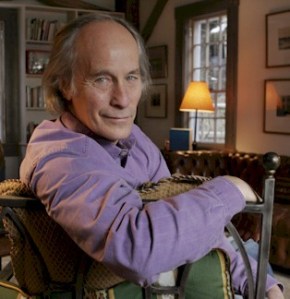
richard-fordIn the current issue of Bookforum, novelist Richard Ford considers whether Frank Bascombe, the narrator of his award-winning trilogy of novels, is “a stand-in for the rest of us”:
“Over the last twenty years, goodwilled readers have occasionally asked me if Frank Bascombe, the yearning, sometimes vexatious, narrator of my three novels The SportswriterIndependence Day, and Lay of the Land—if Frank Bascombe was intended to be an American ‘everyman.’ By this I think these readers mean: Is Frank at least partly an emblem? Poised there in the final clattering quadrant of the last century, beset with dilemmas and joys, equipped with his suburban New Jersey skill set and ethical outlook—do Frank’s fears, dedications, devilings, and amusements stand somewhat for our own?

“Naturally, I’m flattered to hear such a question, since it might mean the questioner has read at least one of these books and tried to make use of it. And I can certainly imagine that a millennial standard-bearer might be worth having; a sort of generalizable, meditative, desktop embodiment of our otherwise unapplauded selves—one who’s not so accurately drawn as to cause discomfort, but still recognizable enough to make us feel a bit more visible to ourselves, possibly recertify us as persuasive characters in our own daily dramas.

“But the truth is that Frank Bascombe as ‘everyman’ was never my intention. Not only would I have no idea how to go about writing such a full-service literary incarnation, but I’m also sure I’d find the whole business to be not much fun in the doing. And I still want to enjoy what I’m doing.” (more @ Bookforum)

“More than 9,000 books are missing from the British Library, including Renaissance treatises on theology and alchemy, a medieval text on astronomy, first editions of 19th- and 20th-century novels, and a luxury edition of Mein Kampf produced in 1939 to celebrate Hitler’s 50th birthday.

“The library believes almost all have not been stolen but rather mislaid among its 650km of shelves and 150m items – although some have not been seen in well over half a century. . . .

“The library records all of these items as ‘mislaid’ rather than gone for ever, still less stolen. Despite well-publicised recent cases – such as that of Edward Forbes Smiley III, convicted in the US three years ago of stealing more than 100 maps from institutions including the British Library, and Farhad Hakimzadeh, an Iranian collector jailed in January for cutting maps, illustrations and pages from priceless volumes in the British Library and other collections – the library is convinced that almost all the missing texts are still somewhere within its walls.” (more @ The Guardian)

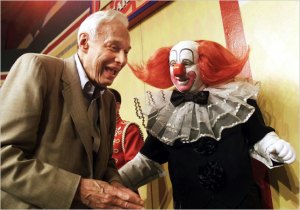
bozo“Alan W. Livingston, an entertainment executive who had significant roles in bringing Bozo, the Beatles and ‘Bonanza‘ to American audiences, died Friday at home in Beverly Hills. He was 91. . . .

“In 1963, Mr. Livingston was president of Capitol Records, which had declined three different times to release singles by a British band, then little known in the United States, called the Beatles. After another Capitol executive turned down a fourth opportunity, this one to release the song ‘I Want to Hold Your Hand,’ a telephone call placed to Mr. Livingston probably changed rock ‘n roll history. . . .

“Capitol released the single and the next year brought the Beatles to the United States, unleashing the tsunami of adoration that came to be known as Beatlemania.” (more @ NY Times)